
Team Descriptions
Academic Detailing
New to the ED! AD is an effective method of providing 1:1 training between the detailer and the clinician in short modules (15-20 minutes). The academic detailer provides the latest evidence for pain management in a conversational interaction that is tailored to a particular ordering provider’s knowledge and bias. Although physicians are the primary target of the intervention, we will also provide this education to RNs as they may be a driver of influencing practice patterns with younger physician trainees. AD will cover educational material and the clinical decision support.
Education
Utilizing evidence-based guidelines, including SAMHSA’s Technical Assistance and American College of Emergency Physicians (ACEP) Opioid and Pain resources, to construct culturally sensitive, trauma-informed, and geographically specific education curricula. Trainings will also include: a) best-practice evidence on managing frequent painful conditions; b) recognition and treatment of opioid use disorder); c) take-home naloxone; and d) appropriate outpatient referrals for ongoing pain management including strategies such as referral to physical therapy, pain management, or – if OUD is suspected – the UAMS addictions clinic. Our Education Team are experts in evidence-based medicine and will be supported by Co-PIs who has extensive experience with development of curricula. The team work with relevant committees to build consensus and engage appropriate stakeholders for implementation.
Evaluation
The evaluation team supports the overall mission of the program. The role of the team is to assist with planning, designing, collecting/analyzing data to report findings, and assist programs in continuous learning and quality improvement.
Peer Support Specialists
New to the ED! Utilizing peer recovery support specialists certified by the State of Arkansas who have lived experience of pain, peers will work with patients discharged from the ED.
Peers will focus on:
- self-management of pain (without opioids),
(if opioids are prescribed)
- opioid hazards, including proper use and disposal,
- take-home naloxone,
- linkage with an appropriate outpatient pain management or addictions clinic as needed; and
- help overcome barriers to linkage if an ED referral was already made.
Leadership
The leadership team provides oversight for the SAMHSA grant.
Team Members
- All
- Academic Detailing
- Education
- Evaluation
- Leadership Team
- Peer Support Specialist
- Ultrasound Specialist
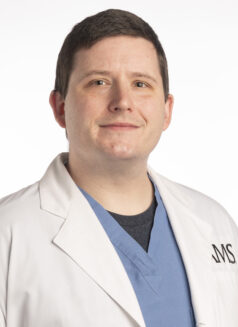
Dr. Arthur graduated from the University of Central Arkansas with a degree in Political Science. He attended graduate and medical school at the University of Arkansas for Medical Sciences where he received his medical degree and Master in Public Health degree. He completed his Emergency Medicine residency at the University of Florida College of Medicine – Jacksonville in Jacksonville, Florida. As a resident, he received numerous teaching awards including the Department of Emergency Medicine Service Award, Department of Emergency Medicine Outstanding Senior Resident Award, University of Florida Society of Teaching Scholars Outstanding Resident Teacher Award, and the Rosilie O. Saffos Award for Outstanding Resident Teacher of the Year. Following residency, he returned to the University of Arkansas for Medical Sciences and completed his fellowship in Emergency Ultrasound. After Fellowship he remained on faculty in the Department of Emergency Medicine, Division of Emergency Ultrasound and the Department of Pediatrics, Division of Pediatric Emergency Medicine. He is a member of the Society of Academic Emergency Medicine and the American College of Emergency Physicians. His professional areas of interest include medical education, advanced echocardiography and Resuscitative TEE, ultrasound-guided regional anesthesia, airway management, and Emergency Medicine research.

Brett Bailey, Pharm.D., is Associate Chief Clinical Informatics Officer for Pharmacy, Analytics, and Research at UAMS Medical Center. He leads analytics strategy, EMR optimization, and data infrastructure to improve care quality and research output. At UAMS College of Pharmacy, he serves as Assistant Professor and site coordinator for the PGY-2 Population Health Management & Data Analytics residency, directing training in informatics, automation, and quality improvement. Brett has authored peer-reviewed research on clinical decision support, pain management, and implementation science. A licensed pharmacist and recognized educator, he is committed to advancing clinical informatics and value-based care at UAMS.

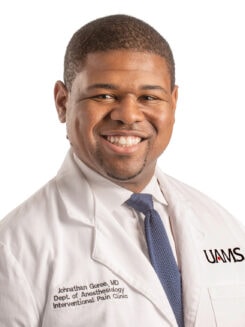
Board certified in anesthesiology and pain medicine, Dr. Johnathan Goree is a proud alumnus of Catholic High School in Little Rock, Arkansas. He received his Bachelor of Arts in biology from Washington University in St. Louis. He then moved to New York City where he completed both his medical degree and residency in anesthesiology at the Weill College of Medicine at Cornell University. Following his time in Manhattan, he completed a fellowship in interventional pain management at Emory University Hospital in Atlanta, Georgia. In 2014, Dr. Goree returned home to Little Rock, Arkansas to join the faculty at UAMS where he serves as the Director of Interventional Pain Management Services and an Assistant Professor in the Department of Anesthesiology. He primarily focuses on the treatment of chronic pain conditions using minimally invasive procedures, spinal cord stimulation, and vertebral augmentation. His specific research interests include gait analysis in patients with degenerative spine conditions and treatment of complex regional pain syndrome.
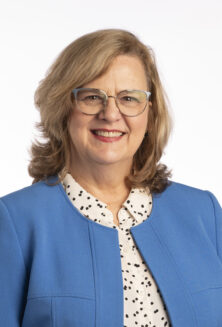
Dr. Hudson was trained as a pharmacist with an emphasis in clinical use of medicines, quality of medication management and medication adherence. Dr. Hudson’s research has focused on understanding the epidemiology of medication use and identifying strategies to improve the safe and effective use of medications for treatment of mental health disorders and understanding the physical health implications of medications to treat these disorders. Dr. Hudson has worked with VA clinicians and opinion leaders to develop strategies to improve quality of medication management, medication adherence and physical health monitoring among individuals receiving antipsychotic medications. Her work with Arkansas Medicaid has concentrated on understanding disparities in medication use among recipients with schizophrenia, bipolar disorder and dementia. More recently, Dr. Hudson has begun research in understanding the risks of opioid use among individuals who use these medications chronically and is participating in research to understand how pharmacists and physicians manage the risks associated with opioid medications.

Director of Anatomical Gift Program, Associate Professor
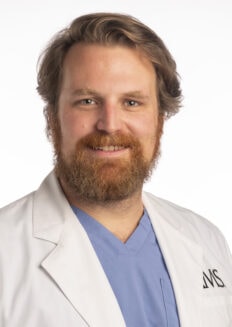

Behavioral Health Integration Hub (BHI-Hub)
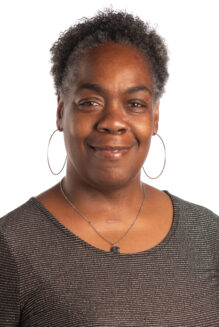
LaTunja Sockwell is a University of Arkansas for Medical Sciences (UAMS) Faculty Research Instructor in the Department of Family and Preventative Medicine’s Research and Evaluation Division. Ms. Sockwell has a Masters in Criminal Justice and over 15 years of research experience with seven years leading and evaluating projects (SAMHSA, Pharma, and CDC). Ms. Sockwell’s research focuses on enhancing substance abuse (SA) treatment and wrap-around services for individuals with co-occurring SA and mental health disorders, youth substance abuse awareness, stigma reduction around HIV and related issues, HIV prevention and linkage to care, and rural healthcare access issues. Ms. Sockwell currently sits on several task forces for the betterment of those that have substance abuse, homelessness, and HIV related issues.
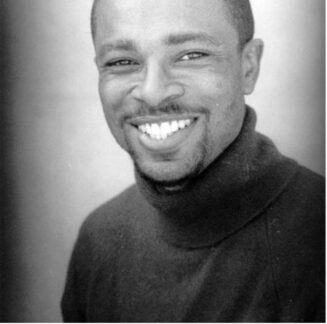
Sean is a dedicated peer support advocate committed to fostering empathy and empowerment within the community. With a background in communication and a passion for mental health awareness, he strives to create a safe space where individuals are heard, understood and supported. Whether you’re facing challenges or celebrating victories, he’s here to lend an empathetic ear and offer guidance on your journey towards wellness.

Dr. Thompson is an Assistant Professor at the University of Arkansas for Medical Sciences (UAMS), Department of Psychiatry, Center for Health Services Research. He conducts both public health and clinical intervention research in the intersecting areas of substance abuse, psychiatric disorders, and suicide and has published over 45 peer-reviewed articles on his work in well-regarded national and international scientific journals. Dr. Thompson has been the Principal Investigator of two NIH-funded studies (R21AA017862; K23DA032323) to develop and test the feasibility and preliminary effectiveness of disseminable brief motivational interventions to reduce substance use and sexual risk behaviors among homeless young adults. This work included the development and testing of a smartphone application to self-monitor substance use and sexual risk behaviors, plus a brief motivational intervention, that has been shown to reduce such behaviors in this vulnerable population. Dr. Thompson currently serves as: (1) Co-Investigator on a NIDA-funded study (R01DA048022) to (a) develop and evaluate the feasibility of a smartphone application (app) to reduce relapse among individuals receiving outpatient medications for opioid use disorders (MOUD) and (b) use functional neuroimaging to model neurocognitive mechanisms by which the app reduces opioid misuse; (2) Co-Investigator on two studies (VA HSR&D RIVR 19-478; VA HSR&D IIR 20-058) to develop and pilot brief strength-based interventions to link veterans with alcohol problems and/or PTSD to substance abuse and mental health treatment; (3) Co-Investigator on a study to empower veterans to address suicide in their communities; and (4) Co-Investigator and Evaluator on the Arkansas State Opioid Response (SOR3; SAMHSA) to establish and expand MOUD services within the state by compensating facilities across the state to provide MOUD to uninsured and underinsured patients.