A school district and regional health system partnered to improve access to spoken instruction for children with mild, fluctuating, or unidentified hearing loss.
For children in rural Northwest Alaska, an ear infection can affect much more than comfort. Fluid or infection in the middle ear can cause mild or moderate hearing loss that changes as the condition resolves and returns. Because those changes may be difficult to see, a child can spend weeks or months working harder to hear a teacher, follow classroom discussion, and learn in noise.
The Improving Hearing Equality for Academic Readiness (i-HEAR) project explored a practical classroom response. Norton Sound Health Corporation and Bering Strait School District partnered to place sound field systems in six remote schools, bringing a teacher’s voice more evenly throughout the classroom for every student.
i-Hear Participating Schools in Northwest Alaska
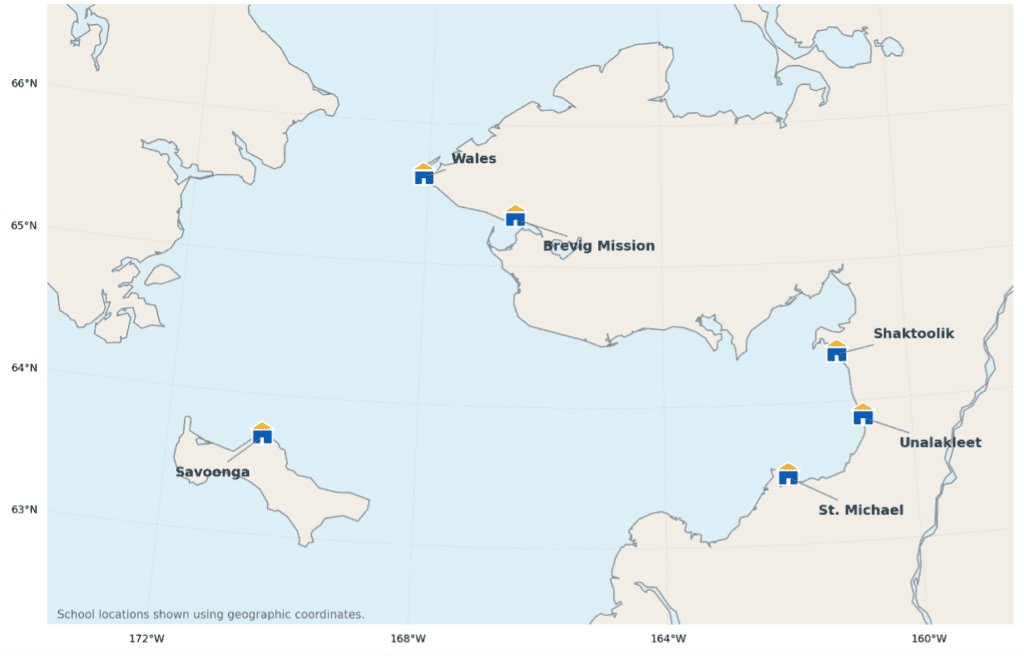
The i-HEAR project deployed classroom soundfield systems in Unalakleet, Wales, Brevig Mission, Savoonga, St. Michael, and Shaktoolik.
Why “mild” hearing loss matters
Classrooms are demanding listening environments. A teacher’s voice becomes softer with distance and must compete with ventilation systems, movement, peer conversations, and reverberation. Children need a clearer speech signal than adults, and even a mild or temporary hearing loss can make it harder to understand speech in noise. These challenges may be greater for young children, multilingual learners, and students with attention, language, or learning differences.
The Bering Strait region spans approximately 23,000 square miles and includes 15 communities that are not connected by road and require small plane or boat for travel. Bering Strait School District serves about 1,800 students, nearly all of whom are Alaska Native and identify as Iñupiaq, Yup’ik, or St. Lawrence Island Yupik. The same communities receive regional health services from Norton Sound Health Corporation. In this setting, hearing supports classroom learning as well as participation in language, storytelling, community life, and subsistence activities.
A universal classroom approach
A sound field system uses a microphone worn by the teacher and a classroom speaker to distribute speech more evenly throughout the room. Unlike an individual hearing device, it is a universal support: all students can hear the amplified teacher, including children whose hearing difficulty is temporary, fluctuating, or not yet identified.
Sound field technology does not treat ear disease or replace diagnostic audiology, medical care, hearing aids, personal remote-microphone systems, or improvements to poor classroom acoustics. Instead, it can complement those services by improving access to instruction while children await evaluation, treatment, or resolution of middle-ear disease.
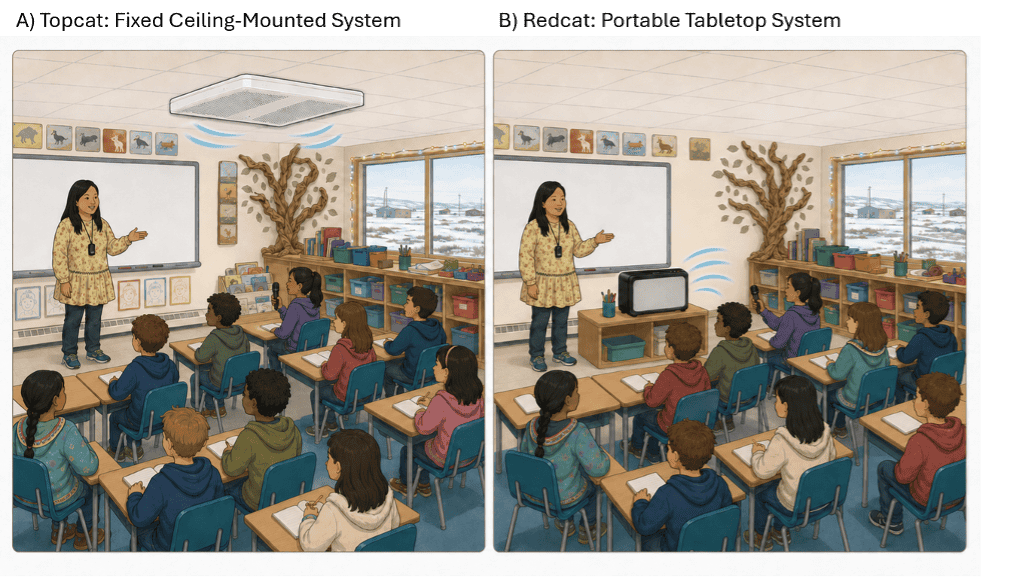
The i-HEAR project used two classroom configurations: a ceiling-mounted Topcat system (left) and a portable Redcat system (right). Both used a teacher-worn microphone and could include a second pass-around microphone.
Bringing sound field systems to remote schools
Bering Strait School District and Norton Sound Health Corporation developed i-HEAR in 2020 with a $60,034 grant from Norton Sound Economic Development Corporation. The project purchased 25 Lightspeed Topcat and Redcat classroom audio systems. One of each type was first installed in Unalakleet, where the district office, information technology and maintenance teams, and Norton Sound Health Corporation’s subregional clinic could support preparation, testing, training, and troubleshooting.
The remaining systems were distributed across schools in Shaktoolik, Wales, St. Michael, Brevig Mission, and Savoonga. The team intentionally included different geographic, linguistic, cultural, grade-level, and classroom contexts. Approximately four systems went to each participating school, with portable and ceiling-mounted configurations selected according to classroom and installation needs.
The COVID-19 pandemic delayed the planned rollout by one school year. Despite school closures, travel restrictions, staffing demands, and rapidly changing classroom arrangements, all 25 systems were ultimately deployed and set up during the 2021–2022 school year.
What implementation required beyond purchasing equipment
Successful deployment depended on collaboration across school and health leadership, audiology, information technology, building maintenance, local administrative staff, and teachers. Ceiling-mounted systems required facilities planning and secure installation. Portable systems offered flexibility but required attention to placement, charging, storage, and daily setup.
The project team translated manufacturer manuals into concise, locally relevant resources for setup, daily use, troubleshooting, cleaning, and summer storage. Teachers learned to wear the microphone near the collarbone, mute it during private conversations, and return it to the charger each day. Each school identified a local superuser for first-line support, while the audiology team provided remote assistance and the vendor remained available for technical issues.
Lessons from the demonstration
Available teacher comments suggested that the systems’ perceived value varied by classroom and instructional context. Some teachers described broad benefits for student access, while others used the technology more selectively for classroom management. These observations reinforce the importance of explaining why consistent microphone use matters: benefits such as reduced listening effort and more equitable access across seating locations may not be immediately visible to a teacher.
The pandemic-related delay and later leadership transitions prevented completion of the planned teacher surveys and academic evaluation. While the project demonstrates the feasibility and practical requirements of deployment, future projects should build a focused evaluation into existing school workflows and examine student-centered outcomes such as literacy, speech perception in noise, listening fatigue, classroom participation, and behavior, along with adoption, consistent use, maintenance, and long-term sustainability.
Looking ahead
The i-HEAR experience shows how a rural school district and regional health system can turn recognition of a common, often invisible hearing challenge into a classroom-level response. It also shows that equipment alone is not enough. Partnership, thoughtful site selection, teacher understanding, local technical capacity, recurring training, and clear plans for evaluation and sustainment are all essential.
More rigorous research is needed to determine whether universal classroom sound field systems improve literacy and other outcomes for children with mild and fluctuating hearing loss. For remote and underserved schools, the i-HEAR project provides a practical starting point and reinforces an important message: “mild” may describe the degree of hearing loss, but not its impact on classroom learning.