

Associate Professor
Healthcare System
Phone: 501-686-8655
Email: rickyleung@uams.edu
Education
- Ph.D. – The Chinese University of Hong Kong, 2001
- Postdoctoral Fellowship – University of Massachusetts Medical School (research focused on the contribution of estrogen receptor beta to prostate cancer)
Research Interests
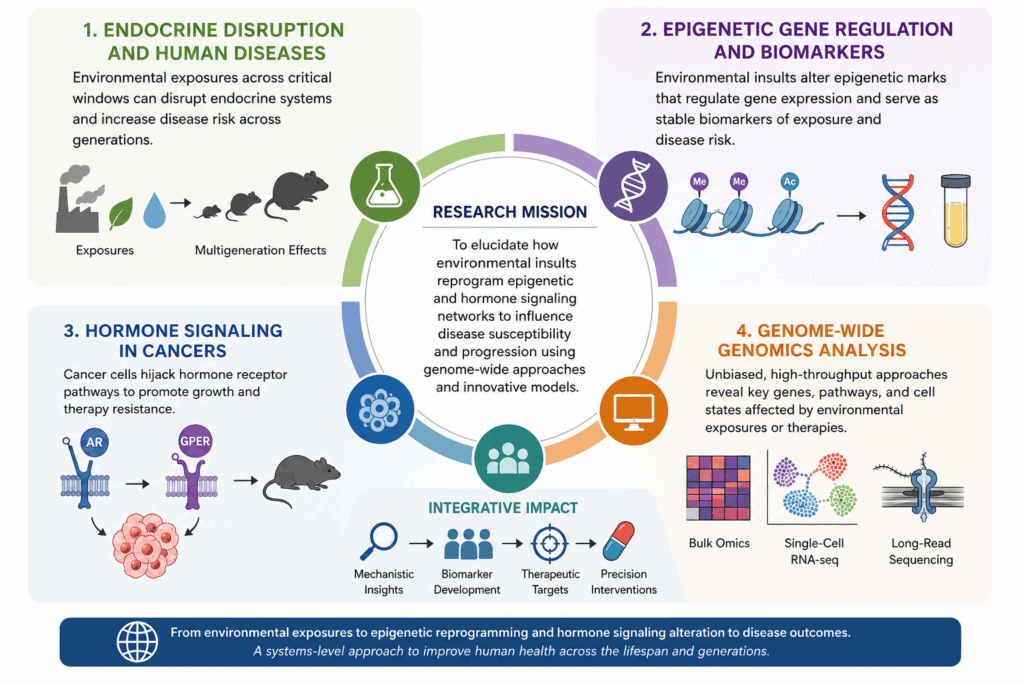
Endocrine disruption and human diseases – Endocrine disruptors (EDCs) are ubiquitous and can modify disease risk. But the underlying mechanism remains largely unknown and it is unclear how EDCs interfere with our endocrine systems. Using transcriptomic change as an endpoint, we showed that an environmental estrogen prototype, Bisphenol A (BPA) does not follow a classical toxicological dose-response relationship (i.e. higher dose results in greater response). We are currently studying the endocrine-disrupting effects of metals (including lead and arsenic) and determine their underlying epigenetic changes in an intergeneration animal model.
Epigenetic gene regulation and biomarkers – Genes are regulated by epigenetics, a mechanism that involves DNA methylation, microRNA expression, or histone tail modification. However, it is unclear how epigenetics coordinates with other transcription factors or chromatin remodeling factors in regulating gene expression. Our laboratory is working to uncover the upstream signals that regulate epigenetics and dissect the relationship between DNA methylation and cis-acting elements during transcription. Our lab found that this particular epigenetic mechanism is highly susceptible to environmental insults. Once altered by environmental exposure, many of the molecular changes are stable throughout life, making them excellent biomarkers for monitoring exposures and/or for assessing the underlying disease susceptibility associated with exposures.
Hormone signaling in cancers – The etiology of prostate cancer is still largely unknown. My research team has been exploring mechanisms by which prostate cancer develops and progresses into an aggressive cancer type. We specifically found that cancer cells hijack the hormone receptor pathway to gain growth benefits. One of the latest members of the estrogen receptor (ER) family is called G-protein-coupled estrogen receptor (GPR30 or GPER). Unlike traditional nuclear estrogen receptors ERalpha or ERbeta, GPER is a membrane receptor going through extra-nuclear signaling. Our laboratory recently observed that this receptor was highly expressed in castration-resistant prostate cancer cells and is dissecting its upstream androgen receptor signaling using in vitro and in vivo models.
Genome-wide genomics analysis – Instead of focusing on one-gene one-target approach and finding out potential targets based on published data, our laboratory employ multiple genome-wide approaches to identify key players involved in each experiment. In particular, we used microarray, PCR array and next-generation sequencing to uncover major signaling network changes induced by environmental toxicants or therapeutic drugs in cancers. Currently, we are using single-cell RNA sequencing methods to study the effects of environmental toxicant on several novel subpopulations of prostate stem cells and conducting direct RNA sequencing techniques using nanopore-based platform to identify the change of epitranscriptomics upon environmental exposure.
Recent Research Support
Current Research
- NIH/NIEHS R01ES032675 (co-Principal Investigator) 4/29/2022-4/28/2027 “RNA modifications by paternal exposure to arsenic and intergenerational effects on sperm quality”
- DOD Investigator-Initiated Research Award W81XWH2210152 (Co-Investigator) 5/1/2022-4/30/2027 “DNA methylation markers associated with exposure and adverse health outcomes in Veterans exposed to airborne hazards from open burn pits”
Publications
- Wanchai, V., Bustamante-Gomez, N.C., Kurilung, A., Beenken, K.E., Cortes, S., Smeltzer, M.S., Leung, Y.K., Xiong, J., Almeida, M., O’Brien, C.A., and Nookaew, I. (2026) A transcriptomic-driven segmentation and cell simulation framework for high-resolution spatial transcriptomics and cell-cell communication. bioRxiv. PMID: 42094555 PMCID: PMC13142509
- *#Leung, Y.K., #Ouyang, B., Cheong, A., Karyala, S.V., Chen, J., Medvedovic, M, Ying, J. and *Ho, S.M. (2026) Service Year-Dependent Disruption of Reproductive Hormones and Altered DNA Methylation in Male Firefighters. Journal of Occupational and Environmental Medicine In press. PMID: 42262377
*co-corresponding authors; #co-first authors - Shahror, R.A, Zaman, B., Chuesiang, P., Wild, M., Shosha, E., Leung, Y.K., Mu, S., Rusch, N.J., Fouda, A.Y. (2026) CD5L promotes efferocytosis and resolution of retinal ischemic injury. Cell Death and Disease 17(1):520. PMID: 42009635 PMCID: PMC13222871
- Kirkpatrick, C., Quick, C.M., Post, S., Leung, Y.K., Dings, R.P.M., Paulos, C.M., Burdine, L., Lu, Y-C.W. (2026) Detection of mitochondrial DNA mutations in T cells following 5-FU or cisplatin exposure. Cell Reports Medicine 7(3):102663. PMID: 41812664 PMCID: PMC13006443
- Puvvula, J., Braun, J.M., DeFranco, E.A., Ho, S.M., Leung, Y.K., Huang, S., Zhang, X., Vuong, A.M., Kim, S.S., Percy, Z., Chen, A. (2025) Epigenetic signatures of maternal-fetal health: insights from cord blood and placenta. Epigenetics, 20(1):2508067. PMID: 40405669 PMCID: PMC12118431
- Kirkpatrick, C., Hao, S., Quick, C.M., Post, S., Leung, Y.K., Burdine, L., Lu, Y-C.W. (2025) Isolation of mitochondrial mutation-specific T-cell receptors. The Journal of Immunology, 214(10):2770-2780. PMID: 40587813 PMCID: PMC12576121
- Puvvula, J., Song, L.C., Zalewska, K.J., Alexander, A., Manz, K.E., Braun, J.M., Pennell, K.D., DeFranco, E.A., Ho, S.M., Leung, Y.K., Huang, S., Vuong, A.M., Kim, S.S., Percy, Z., Bhashyam, P., Lee, R., Jones, D.P., Tran, V., Kim, D.V., Calafat, A.M., Botelho, J.C., Chen, A. (2025) Global metabolomic alterations associated with endocrine-disrupting chemicals among pregnant individuals and newborns. Metabolomics. 21(1):20. PMID: 39863779 PMCID: PMC11762426
- Shahror, R.A., Shosha, E., Ji. M.H., Morris. C.A., Wild. M., Zaman. B., Mitchell, C.D., Tetelbom, P., Leung, Y.K., Phillips, P.H., Sallam, A.A., Fouda, A.Y. (2024) Proteomic Analysis of Aqueous Humor in Central Retinal Artery Occlusion: Unveiling Novel Insights Into Disease Pathophysiology, Translational Vision Science & Technology, 13(8):30. PMID: 39163016 PMCID: PMC11343007
- Cortes-Ramirez, S.A., Ho. S.M., Leung. Y.K. (2024) Endocrine-Disrupting Chemicals: A Looming Threat to Current and Future Generations, International Journal of Molecular Sciences, 25(15):8222. Editorial PMID: 39125790 PMCID: PMC11311772
- Puvvula, J., Braun, J.M., DeFranco, E.A., Ho, S.M., Leung, Y.K., Huang, S., Zhang, X., Vuong, A.M., Kim, S.S., Percy, Z., Calafat, A.M., Botelho, J.C., Chen, A. (2024) Gestational exposure to environmental chemicals and epigenetic alterations in the placenta and cord blood mononuclear cells, Epigenetics Communication, 4(1):4. PMID: 38962689 PMCID: PMC11217138
- Leung, Y.K., Lee, S.G., Wang, J., Guruvaiah, P., Rusch, N.J., Ho, S.M., Park, C., Kim, K. (2024) The Loss of an Orphan Nuclear Receptor NR2E3 Augments Wnt/β-catenin Signaling via Epigenetic Dysregulation that Enhances Sp1-β catenin-p300 Interactions in Hepatocellular Carcinoma, Advanced Science, 11(29):2308539. PMID: 38790135 PMCID: PMC11304255