
Binyam Belachew, a graduate student in Kevin Raney’s lab presented a poster at the theFASEB Helicase and Nucleic Acid-based Machine Conference in Steamboat Springs, CO.

Binyam Belachew, a graduate student in Kevin Raney’s lab presented a poster at the theFASEB Helicase and Nucleic Acid-based Machine Conference in Steamboat Springs, CO.
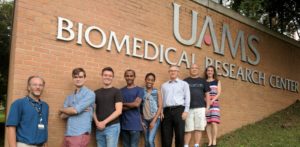
July 26, 2019 | Twelve undergraduate students from across the United States worked in real labs, doing real research this summer at UAMS — many of them for the first time.
The Summer Undergraduate Research Program to Increase Diversity in Research is hosted annually by the UAMS Graduate School and Center for Diversity Affairs and is funded by the National Heart, Lung and Blood Institute, part of the National Institutes of Health.
For nine weeks, the students perform research at UAMS with the help of a mentor. They network with scientists, see real-life surgeries, cultivate leadership skills and attend lectures on conducting research skillfully and ethically. At the end of their journey, they present their work at the Central Arkansas Undergraduate Summer Research Symposium at UAMS.
Nikyshaliz Velazquez is one of the 2019 SURP students. She is a senior studying microbiology at the University of Puerto Rico. She spent the summer working with Jerry Ware, Ph.D., on platelets in the UAMS College of Medicine Department of Physiology and Biophysics.
“We want to know if platelets have another function,” Velazquez said. “We know that platelets form clots, but we want to know if they also play a role in systematic inflammation.”
Outside of the lab, the students have gotten together throughout the summer for seminars on everything from preparing a CV to career options to finding your voice as a leader and uncovering your strengths.
“This is my first time doing research in a lab,” Velazquez said. “The most useful part of the program to me has been being in the lab because I don’t know what I’m going to do after graduation. I’m thinking of doing a Ph.D. or going to med school. So doing the actual work has helped me get closer to making that decision and so have the seminars.”
SURP participant Eva Davis said she is asking herself the same question: Ph.D., M.D., or both. Davis is from Fayetteville, North Carolina, and is going into her junior year at Hampton University in Virginia, where she is studying cellular and molecular biology. She knows she wants to teach at a historically black college or university and be part of increasing the number of black women in scientific careers, but she doesn’t know which degree path is best for her.
Davis worked with Mari K. Davidson, Ph.D., as her mentor in the Department of Biochemistry and Molecular Biology. She is working on a project involving aneuploidy, or an abnormal number of chromosomes in a cell, and one of its major causes, recombination error, or the loss or gain of genetic material when chromosomes are copied.
“So I’m looking into what happens during the process and what proteins are important for recombination,” Davis said. “That understanding is important because it can lead us to further understanding the pathways that lead to aneuploidy, which is a common cause of many genetic disorders, including Down syndrome.”
Davis still doesn’t know for sure what the future holds, but she does have a better understanding of what it means to be a scientist.
“Science consists of a lot of failures, but the end results are usually very rewarding,” Davis said. “People can tell you that all day long, but until you experience it yourself, you don’t really know.”
This is the ninth year for the SURP program at UAMS.
“SURP helps individuals, but it also invests in our scientific community of the future,” said Brian E. Gittens, Ed.D., vice chancellor for diversity, equity and inclusion at UAMS. “We hope these students stay in the sciences and increase the diversity among career research scientists. When we have diversity among research topics, our reward is a diversity of thought, problem solving and solutions that impact the lives and health of all Arkansans and the broader society.”
“The SURP program introduces many key scientific concepts that will serve these students throughout their careers,” said Robert E. McGehee Jr., Ph.D., dean of the UAMS Graduate School. “They learn what it’s like to be in a lab, they learn the sometimes rocky road to scientific success, and they learn the important step of communicating their work to the public.”
Students receive a salary and financial assistance with travel. The program is open to all, but students with a background in biology or chemistry who are from an underrepresented group (African American, Hispanic American, Native American, Alaska native, Hawaiian native, or native of the U.S. Pacific Islands), disabled, or from a disadvantaged background are encouraged to apply. The application is typically due in February. For more information, find the SURP program online or contact Dr. Latrina Prince (princelatrina@uams.edu).
Wahls WP
PNAS 2019
A Time-Embedding Network Models the Ontogeny of 23 Hepatic Drug Metabolizing Enzymes.
Matlock MK, Tambe A, Elliott-Higgins J, Hines RN, Miller GP, Swamidass SJ.
Chem Res Toxicol. 2019
The Translational Research Institute (TRI) announced today that five early career UAMS researchers will receive KL2 Mentored Research Career Development Program Scholar Awards.
The program provides two years of didactic and mentored research training. Scholars receive 75% salary support and up to $25,000 per year for research, tuition, travel expenses and education materials.
The KL2 Scholars were chosen from 11 applicants. Below are the new scholars, their college, department and title of their KL2 project:
Four UAMS postdoctoral trainees recently became the inaugural recipients of the Translational Research Institute (TRI) Health Science Innovation & Entrepreneurship (HSIE) Postdoctoral Scholars Program Awards.
Funded by TRI’s Clinical and Translational Science Award (CTSA) TL1 Program, the 15-credit graduate entrepreneurship training includes a significant new partnership with the University of Arkansas, Fayetteville, Sam M. Walton College of Business, which will provide distance education courses to the scholars. The scholars will work with MBA student teams at the UA to develop commercialization plans for health-science technologies conceived at UAMS.
The program spans two years as a complement to the scholars’ existing mentored research training.
The scholars and their research mentors are:
Andrea Edwards, a graduate student in Kevin Raney’s lab was selected to give both an oral and a poster presentation at the NAD+ Metabolism and Signaling Conference in Dublin, Ireland.
 Effect of Sulforaphane and 5-Aza-2′-Deoxycytidine on Melanoma Cell Growth.
Chiang TC, Koss B, Su LJ, Washam CL, Byrum SD, Storey A, Tackett AJ.
Medicines (Basel). 2019 .
Direct quantification of the translocation activities of Saccharomyces cerevisiae Pif1 helicase.
Lu C, Le S, Chen J, Byrd AK, Rhodes D, Raney KD, Yan J.
Nucleic Acids Res. 2019
Biotransformation and Bioactivation Reactions – 2018 Literature Highlights.
Khojasteh SC, Bumpus NN, Driscoll JP, Miller GP, Mitra K, Rietjens IMCM, Zhang D.
Drug Metab Rev. 2019
Dr. Robert Eoff has received a new, four-year grant award from the NSF. The award is for ~1.2 million to study “Replication of G-quadruplex DNA by translesion polymerases”. Dr. Julie Gunderson of Hendrix College is co-Investigator on the grant.
Andrea Edwards, a graduate student in Kevin Raney’s lab was selected as a Southern Regional Education Board SREB-Doctoral Scholars Program recipient for 2019-2020. Her graduate studies will be funded through a partnership arrangement between SREB, the State of Arkansas, and the University of Arkansas for Medical Services. She will also have her expenses paid to attend the annual Institute on Teaching and Mentoring. Congratulations Andrea!
Dr. Magdalena Delgado who recently completed her Ph.D. in Dr. Tim Chamber’s lab has been awarded the Alan D. Elbein Award for Research Excellence. The award is named in honor of Dr. Alan D. Elbein, who was Chair of the Department of Biochemistry & Molecular Biology from 1991 until 2009 and is given to graduate students that have shown extraordinary research performance during their graduate career. Areas of evaluation include but are not limited to fellowships, manuscripts, and presentations of research. Congratulations Dr. Delgado!