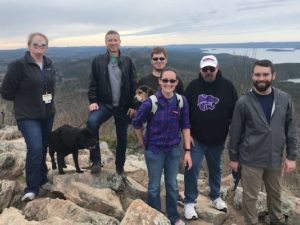
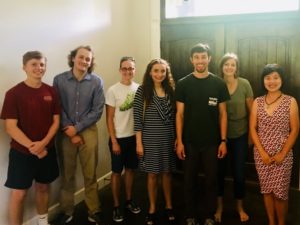
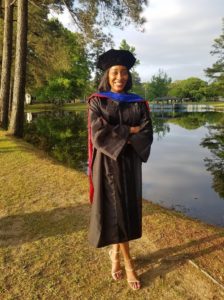
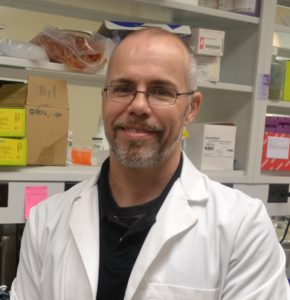
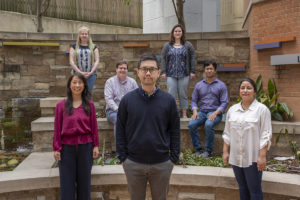
The UAMS Translational Research Institute (TRI) Health Sciences Innovation and Entrepreneurship (HSIE) Postdoctoral Training Program has named six postdoctoral scholars for its class of 2023. The scholars, selected in a competitive application process, will begin two years of mentored entrepreneurship training July 1.
The program, which includes stipends up to $57,000 per year, is designed to help promising scientists more quickly move their discoveries into everyday practice by teaching them commercialization and team science skills.
The HSIE Postdoctoral Scholars – all from the UAMS College of Medicine – their research project plans and mentors are:

Laura Ewing, Ph.D., Department of Biochemistry and Molecular Biology and Winthrop P. Rockefeller Cancer Institute. Her project will focus on identifying predictors of the development, progression or recurrence of different types of ovarian cancer.
Mentor: Michael Birrer, M.D., Ph.D.

Kindann Fawcett, Ph.D., Department of Pediatric Neurology at Arkansas Children’s Hospital (ACH). Her project will focus on development of a tool to assess risk and best practices in regards to nutrition and its role in the standard care provided for patients at ACH and UAMS. Secondly, she will focus on the creation of a digital media and virtual, interactive learning platform for nutrition and exercise curriculum to educate the youth of Arkansas.
Mentor: Aravindhan Veerapandiyan, M.D.

Tiffany Miles, Ph.D., Department of Neurobiology and Developmental Sciences.
Her project will focus on hormonal deficiencies related to obesity and then establishing a platform to educate Arkansans on the impact of maternal nutrition in offspring development.
Mentor: Angus MacNicol, Ph.D.

Thomas Nienaber, M.D., Department of Pediatrics – Division of Neonatology. His project will address improving the neonatal mechanical ventilation by optimizing the endotracheal tube.
Mentor: Kevin Sexton, M.D.

Megan Reed, Ph.D., Department of Biochemistry and Molecular Biology. Her project will focus on the use of comparative transcriptomics pipeline to generate and validate patient-specific treatment options for glioblastoma tumors.
Mentors: Alan Tackett, Ph.D., and Analiz Rodriguez, M.D., Ph.D.
Julia Tobacyk, Ph.D., Department of Pharmacology and Toxicology. Her project will focus on the development of new treatments for opioid use disorder in pregnancy.
Mentor: Lisa Brents, Ph.D.
The program, which includes stipends up to $57,000 per year, is designed to help promising scientists more quickly move their discoveries into everyday practice by teaching them commercialization and team science skills.
It is supported by the NRSA Training Core (TL1) component of the UAMS Clinical and Translational Science Award, grant TL1 TR003109.
“Our program goal is to accelerate biomedical discoveries to improve health and health outcomes,” said Nancy Rusch, Ph.D., who co-directs the program for the UAMS Translational Research Institute. “I am very enthusiastic about this group of scholars. They all have exceptional talent and they are pursuing projects than can make a real difference.”
The HSIE Postdoctoral Training Program has traditionally provided support annually for eight postdoctoral fellows (four in each year of the two-year program). However, this year the program was able to admit a clinical fellow in addition to five postdoctoral fellows. The expansion relied on postdoctoral stipends provided by the Winthrop P. Rockefeller Cancer Institute, the Arkansas Children’s Research Institute, and the Department of Pediatrics – Division of Neonatology. The program curriculum represents a partnership between the UAMS Translational Research Institute and the Entrepreneurship Graduate Program in the Sam M. Walton College of Business at the University of Arkansas, Fayetteville.
In addition to Rusch, professor and chair of the Department of Pharmacology and Toxicology and executive associate dean for research in the College of Medicine, the program’s leadership team includes co-director Kevin Sexton, M.D., associate professor in the Department of Surgery, and Nancy Gray, Ph.D., president of BioVentures and professor in the Department of Pharmacology and Toxicology. Pamela Kahler is program manager.
The first group of HSIE Scholars named in July 2019, who will be graduating from the program this spring are: Melody Greer, Ph.D. (mentor, Fred Prior, Ph.D.), Samir Jenkins, Ph.D. (mentor, Robert Griffin, Ph.D.), Astha Malhotra, Ph.D. (mentors, Amanda Stolarz, Pharm.D., Ph.D.; and Jawahar Mehta, M.D., Ph.D.), and Aaron Storey, Ph.D. (mentor, Rick Edmondson, Ph.D.). The second group of HSIE Scholars named in July 2020 are: Emilie Darrigues, Ph.D. (mentor, Analiz Rodriguez, M.D., Ph.D.), Shana Owens, Ph.D. (mentor, Craig Forrest, Ph.D.), John Sherrill, M.P.H., Ph.D. (mentor, David Bumpass, M.D.), and Zachary Waldrip, Ph.D. (mentor, Marie Burdine, Ph.D.)