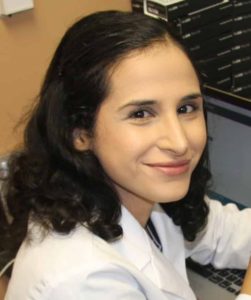
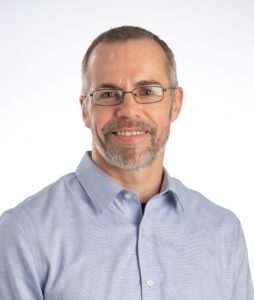
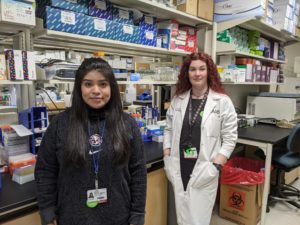
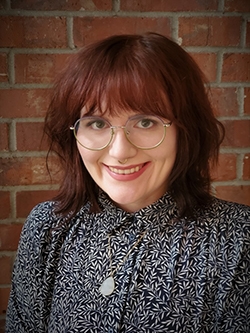
Congratulations to Megan Reed who successfully defended her Ph.D. dissertation entitled “Mechanisms of DNA damage tolerance in glioblastoma” on April 28. Megan was a student in the laboratory of Dr. Robert Eoff and will begin a postdoctoral fellowship in July under the mentorship of Dr. Analiz Rodriguez and Dr. Alan Tackett. Dr. Reed’s postdoctoral studies will be funded by Health Sciences Innovation and Entrepreneurship TL1 program from the Translational Research Institute.
Department News
UAMS Cancer Researcher Receives $1.1 Million as Part of NIH Grant at University of Arkansas, Fayetteville
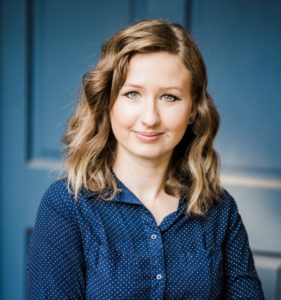
A National Institutes of Health (NIH) grant will allow UAMS researcher Isabelle Racine Miousse, Ph.D., to ramp up her study of a nutrient that may have a role in the effectiveness of immunotherapy for cancer patients.
Miousse will receive $220,000 per year for up to five years as one of four project leaders at the Arkansas Integrative Metabolic Research Center, a new NIH-funded Center of Biomedical Research Excellence (COBRE) at the University of Arkansas, Fayetteville. The university announced April 6 that the center will receive $10.8 million over five years.
The funding will support Miousse’s preclinical cancer studies involving methionine, an amino acid important for human growth and derived primarily from consuming meat.
Miousse, an assistant professor in the UAMS College of Medicine Department of Biochemistry and Molecular Biology, will test whether reducing dietary methionine can improve results of immunotherapy drugs used to treat melanoma patients.
“This has never been tried in combination with immunotherapy drugs,” Miousse said, noting that immunotherapy alone works remarkably well, but only for 50% of melanoma patients. “So far the results of this research are very encouraging, and I am hopeful that this next phase of study will take us into clinical trials.”
Unlike most cancer treatments, she notes, this one has beneficial side effects.
“Reducing methionine in the diet promotes the metabolism of fats and sugars in animal models,” Miousse said. “Methionine restriction could fight cancer and improve general health at the same time.”
Miousse’s work has been supported by the UAMS Translational Research Institute’s two-year KL2 Mentored Research Career Development Award for promising early career researchers. The KL2 provides salary support, research seed funding of $50,000 and translational research training. The institute is supported by a Clinical and Translational Science Award from the NIH National Center for Advancing Translational Sciences.
Alan Tackett Named Arkansas Research Alliance Fellow
Edward T.H. Yeh, M.D., a cardiologist renowned in the field of onco-cardiology, was named an ARA Scholar, and Alan Tackett, Ph.D., a cancer researcher widely recognized for his work in cancer biomarker discovery, was honored as an ARA Fellow.
Yeh will receive $500,000 and Tackett will receive $75,000 to further their research.
“We are extremely proud to have both a new ARA Scholar and ARA Fellow at UAMS. The leadership demonstrated by Dr. Yeh and Dr. Tackett has made a valuable impact on research programs at UAMS. We are fortunate to have them in Arkansas and look forward to their future successes,” said Cam Patterson, M.D., MBA, UAMS Chancellor and UAMS Health CEO.
The ARA Scholars program helps recruit and support world-class researchers to universities where their work helps strengthen the competitiveness of the state.
The ARA Fellows program recognizes research leaders who are currently working in Arkansas at one of the state’s five research campuses.
“The ARA Scholars program is the cornerstone for our organization and bridges the gap between university research and economic development, while our Fellows program recognizes research leaders who have already made an impact in our state,” said Jerry Adams, ARA president. “We anticipate great things from both Dr. Yeh and Dr. Tackett as they build upon their outstanding research portfolios and explore new paths in the future.”
Yeh joined UAMS in 2020 as chair of the Department of Internal Medicine and the Nolan Family Distinguished Chair in Internal Medicine in the College of Medicine.
From 2000 to 2016, he served as professor and founding chair of the Department of Cardiology at the University of Texas MD Anderson Cancer Center in Houston, where he made seminal contributions to understanding the relationships between cancer, chemotherapy agents and heart disease. In 2012, his laboratory discovered that Topoisomerase 2b is the molecular basis of anthracycline-induced cardiotoxicity, upending decades of belief that toxicity to this chemotherapy drug was due solely to reactive oxygen species (ROS) generation.
Earlier, Yeh made important contributions in biochemistry, including the discovery of two ubiquitin-like proteins, SUMO/Sentrin and NEDD8. Both of these proteins are important in regulation of hypoxia-inducible factor stability, DNA repair, heart and lymphoid development, cancer pathogenesis, and sudden death and seizure disorders.
Tackett’s research involves using advanced technology to discover molecular pathways essential for the development of new therapies and finding new biological markers to assist in developing a personalized treatment for each patient’s specific needs.
He is deputy director of the UAMS Winthrop P. Rockefeller Cancer Institute, professor in the UAMS College of Medicine Department of Biochemistry and Molecular Biology and holder of the Scharlau Family Endowed Chair in Cancer Research.
In 2020, Tackett was awarded a $10.6 million grant from the National Institutes of Health (NIH) establishing the IDeA National Resource for Quantitative Proteomics as the first NIH National Resource in Arkansas, which serves biomedical researchers across the nation.
Dr. Leung presenting for Research Antipasto
Research and Innovation is hosting the next Research Antipasto monthly event (informal online networking, casual mentoring, happy hour-ish get-together) at noon on April 6, 2021. Justin Leung, Ph.D., M.Sc. will host. Justin is an assistant professor in the Department of Radiation Oncology with a secondary appointment in the Department of Biochemistry and Molecular Biology. Justin recently received his 3rd NIH R01. Justin’s research interests include chromatin biology, epigenetics, DNA damage, and more.
On the first Tuesday of each month, Research Antipasto’s host will share career experiences, stories, answer questions, advise, astound, and amaze…for 30 to 60 minutes (or until we all have to catch another meeting). Just log in, have fun, and get to know others in the research community! Hosts are posted on the research calendar.
UAMS’ Justin Leung, Ph.D., Receives $1.47 million Grant from National Cancer Institute to Study DNA Damage Regulation
Leung’s project is a collaboration with Robert Eoff, Ph.D., a professor in the Department of Biochemistry and Molecular Biology in the UAMS College of Medicine. Both Leung and Eoff are researchers in the UAMS Winthrop P. Rockefeller Cancer Institute.
“Our work will potentially provide a fundamental understanding of the molecular mechanism of DNA damage regulation in our body and also reveal potential targets for cancer therapeutic development,” said Leung, an assistant professor in the UAMS College of Medicine Department of Radiation Oncology.
Work on the NCI grant, “Mechanistic Characterization of Cell Cycle-Dependent DNA Repair,” focuses on dissecting the molecular mechanism on cell cycle-regulated DNA repair, specifically during early DNA replication. Leung and Eoff hope to identify a key group of proteins known as a histone-mark reader that work together to protect our genetic material from DNA damage.
The NCI grant comes on the heels of Leung receiving a four-year, $792,000 American Cancer Society Research Scholar grant to study DNA repair mechanisms. He will use that grant to investigate how signaling molecules on chromatin interact with proteins that repair broken DNA during replication.
In September 2020, the National Institute of General Medical Sciences awarded Leung a $1.9 million grant in support of the researcher’s roadmap project, “Deciphering the Chromatin-based DNA Damage Response Pathway.”
Explore career options with job simulations
Are you a student or postdoc who is uncertain about your career goals? InterSect has job simulations for a wide variety of Ph.D. level scientific career.
February publications
Ketkar A, Smith L, Johnson C, Richey A, Berry M, Hartman JH, Maddukuri L, Reed MR, Gunderson JEC, Leung JWC, Eoff RL. Nucleic Acids Res.

Differences in cell death in methionine versus cysteine depletion.
Wallis KF, Morehead LC, Bird JT, Byrum S, Miousse IR. Environ Mol Mutagen.

Frett B, Saha D, Ryan KR, Lakkaniga NR, Smith EL. ChemMedChem.

Bone remineralization of lytic lesions in multiple myeloma – The Arkansas experience.
Mohan M, Kumar M, Samant R, Van Hemert R Jr, Tian E, Desai S, van Rhee F, Thanendrarajan S, Schinke C, Suva LJ, Sharma S, Milad M, Kendrick S, Zangari M. Bone.

Inhibition of Kpnβ1 mediated nuclear import enhances cisplatin chemosensitivity in cervical cancer.
Chi RA, van der Watt P, Wei W, Birrer MJ, Leaner VD.BMC Cancer.
Tackett Named Deputy Director of UAMS Winthrop P. Rockefeller Cancer Institute
Highly regarded for his research in cancer biomarker discovery, Tackett is a professor in the UAMS College of Medicine Department of Biochemistry and Molecular Biology. He previously served as associate director of basic research for the UAMS Cancer Institute and holds the Scharlau Family Endowed Chair in Cancer Research.
Tackett is principal investigator for the National Institutes of Health (NIH) (R24) National Resource for Quantitative Proteomics and the NIH (P20) Center of Biomedical Research Excellence in systems biology. His National Cancer Institute-funded research program focuses on the use of cutting-edge systems approaches to identify biomarkers and novel pathways of resistance to cancer therapies.
Tackett will work directly with Michael Birrer, M.D., Ph.D., Cancer Institute director, to expand the research and clinical missions of the Cancer Institute.
“Dr. Tackett’s expertise and insightfulness will be a huge benefit to the Cancer Institute as we continue to grow and move toward our goal of National Cancer Institute Designation,” Birrer said.
Giulia Baldini selected to receive Provost’s Innovator Award
Giulia Baldini, M.D., Ph.D., professor in the Department of Biochemistry and Molecular Biology was selected as one of four inaugural recipients of the Provost’s Innovator Awards. Dr. Baldini is studying a potential new way to treat obesity. Her research is focused on naturally occurring genetic mutations of a receptor found in people with obesity. The receptor is expressed in the hypothalamus, where it controls food intake and energy expenditure. Baldini is targeting the receptor using nanoparticles to deliver a substance that induces appropriate signaling to help regulate weight.
Congratulations Dr. Edwards-Azumara!
Congratulations to Andrea Edwards-Azumara who successfully defended her Ph.D. dissertation entitled “Unpaired Regions in G-Quadruplex DNA Regulate “PARP-1 Enzymatic Activation: Implications for a ROS-Directed Transcription and DNA Repair Event” on February 18th. Andrea was a student in the laboratory of Dr. Kevin Raney and is now a post-doctoral fellow at UT Southwestern under the direction of Dr. William Kraus. A summary of her research is below.
G-Quadruplexes are non-B form DNA structures present at regulatory regions in the genome, such as promoters of proto-oncogenes and telomeres. The prominence in such sites suggests G-quadruplexes serve an important regulatory role in the cell. Indeed, oxidized G-quadruplexes found at regulatory sites are regarded as epigenetic elements and are associated with an interlinking of DNA repair and transcription. PARP-1 binds damaged DNA and non-B form DNA, where it covalently modifies repair enzymes or chromatin-associated proteins respectively with poly(ADP-ribose) (PAR). PAR serves as a signal in regulation of transcription, chromatin remodeling, and DNA repair. PARP-1 is known to bind G-quadruplexes with stimulation of enzymatic activity. We show that PARP-1 binds several G-quadruplex structures with nanomolar affinities, but only a subset promote PARP-1 activity. The G-quadruplex forming sequence found in the proto-oncogene c-KIT promoter stimulates enzymatic activity of PARP-1. The loop-forming characteristics of the c-KIT G-quadruplex sequence regulate PARP-1 catalytic activity, whereas eliminating these loop features reduces PARP-1 activity. Oxidized G-quadruplexes that have been suggested to form unique, looped structures stimulate PARP-1 activity. Our results support a functional interaction between PARP-1 and G-quadruplexes. PARP-1 enzymatic activation by G-quadruplexes is dependent on the loop features and the presence of oxidative damage.