• Skip to primary navigation
  • Skip to main content
  • Skip to primary navigation
  • Skip to main content
Choose which site to search.
University of Arkansas for Medical Sciences Logo University of Arkansas for Medical Sciences
Department of Family and Preventive Medicine: Community Research
  • UAMS Health
  • Jobs
  • Giving
  • Research & Evaluation
    • Arkansas Early Childhood Care & Education Financing: Cost Modeling & Market Price Analysis
    • Arkansas Workforce Studies
    • Child & Youth Mental Health
    • Healthy Families America (HFA)
    • Home-Visiting Support for Low-Birth-Weight Preterm Infants
    • Parents as Teachers (PAT) Arkansas
  • Research-Based Early Childhood Professional Development
    • Engage Continuum
    • FIRST:ECE
    • TIPS
    • WOW
    • Family Map
    • Project PLAY
      • Research & Results
      • Resources
    • REACH
    • WISE
    • Strengthening Families
  • Faculty
    • Nikki Edge, Ph.D.
    • Lorraine McKelvey, Ph.D.
    • Taren M. Swindle, Ph.D.
    • Kanna Lewis, Ph.D.
    • Dong Zhang, Ph.D.
    • Jennifer Harman, Ph.D., IMH-E ®
  • Contact RED
  1. University of Arkansas for Medical Sciences
  2. College of Medicine
  3. Department of Family and Preventive Medicine
  4. Research and Scholarly Activity
  5. Community Research
  6. Research-Based Early Childhood Professional Development
  7. WISE

WISE

WISE models, teaches, and promotes healthy food attitudes in programs that serve children preschool to elementary.

Together We Inspire Smart Eating!

WISE Logo

Kids who eat healthy become adults who eat healthy. Educators use WISE to encourage kids and families to discover fresh, locally grown vegetables and fruits in authentic, developmentally appropriate ways.

Three Education Components

Curricula

We use food experiences, songs, games and activities to help children explore WISE foods and learn healthy eating concepts. The program includes

  • Lesson plans for units focused on 8 different fruits and vegetables
  • Budget-sensitive recipes
  • Fun activities and learning center ideas to integrate food experiences with other learning domains, such as math and reading.

Family Engagement

Technology helps WISE connect to families in appealing ways!

  • Take-home activities and recipes
  • An owl mascot, Windy Wise, who brings letters from local farmers to families
  • Automated content and support for classroom Facebook page

Educator Training

Our six-hour research-based training covers

  • The impact of educators as role models
  • Recommendations for positively influencing children’s eating habits.
  • How to implement WISE in the classroom.

Visit Windy WISE on the web!

Sneak Peek

The WISE curriculum includes eight units, each on a different target food. Each unit introduces new, creative recipes, learning center ideas, and activities. Do them all or pick and choose to suit your program. The curriculum includes creative ideas and step-by-step guidance.

Contents

  • The FIRST Bite
  • Apple Calendar
  • A Letter from the Farmer
  • Apples Arrive
  • Exploring Apples
  • Food Experiences
    • Cooking Applesauce
    • Apple Taste Test
    • Making Yogurt Dip for Apple Wedges
    • Diced Apple Trail Mix
    • Apple Sauce Parfaits
    • Super Simple Shaker Apples
  • Recommended Reading
  • Songs, Poems and Games for Transition Times
  • Extension Activities
  • Learning Center Activities
  • Vocabulary and Skills for Small Chefs
  • The LAST Bite

Food Experience: Cooking Applesauce

Discovery Unit: Apples

When: After introductory activities

Where: Morning small group time, ideally with three small groups of children

Links for Learning:

Collaborative projects, such as this applesauce recipe, are a wonderful way to facilitate teamwork in the classroom. Through experiences such as these, children learn that they can each play a valuable part in an endeavor that benefits the whole group. Consider retelling the classic story of The Little Red Hen, substituting applesauce making for bread baking.

Science and Sensory Connections:

How do apples change as they cook? Encourage children to make predictions and notice changes to color and texture. Can children smell the applesauce as it cooks? How does it smell?

Helpful Hints:

Children will be able to actively help peel and slice apples if you use a rotary peeler/corer/slicer. If this tool is not available, an adult may peel and slice the apples with a knife. To prevent children from becoming bored and restless during this time, consider sharing apple-related songs and rhymes. Examples may be found on page ___.

After eating their applesauce, children will participate in Windy Owl’s “Whooo tried it” chant after trying their applesauce. Remember: this chant can be used during every food experience, as well as any time the target food (apple) is served for breakfast, lunch, or snack!

More to Do:

  • Brainstorm a list of ways to eat apples: apple juice, apple sauce, apple wedges, etc. Display the list in the classroom and add to it throughout the unit as children discover additional ways to eat apples.
  • Later, poll families: “What is your favorite way to serve apples at home?” Make a chart or graph of family responses.

Results

Proven Results!

WISE is effective at increasing fruit and vegetable intake at home.  That’s because WISE was developed using emerging science and parent surveys. Look at the results for an Arkansas Head start program.

We surveyed 806 low income parents and found that 60% used multiple technologies on a daily basis. Plus, they were interested in receiving nutrition and parenting info via technology.
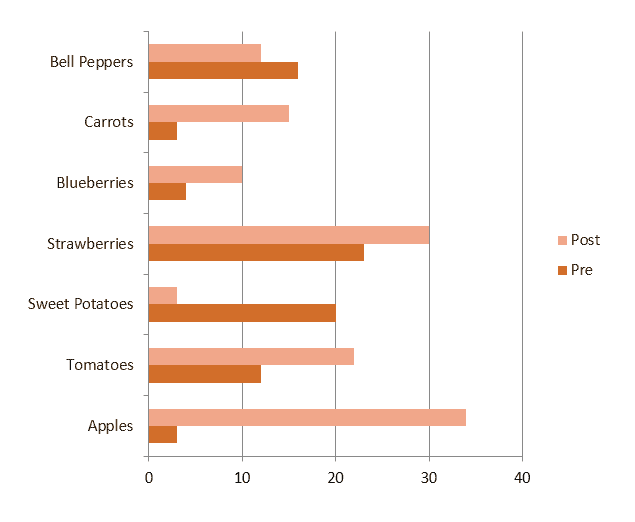
Bar chart describes vegetables and fruit eaten in families both before and after the program. Food includes bell peppers, carrots, blueberries, strawberries, sweet potatoes, tomatoes, and apples. All items show marked improvement, post-program

Number of Families Eating Target Foods Twice Per Week or More. 

Publications About WISE

Swindle, T., Ward, W. L., Bokony, P.A., Pettit, D., & Whiteside-Mansell, L. (2014). Technology use and preference by low-income parents of young children: Demographic patterns and implications for intervention. Journal of Nutrition Education and Behavior. Advance online publication. doi: 10.1016/j.jneb.2014.06.004

Ward, W. L., Swindle, T., Kyzer, A., Whiteside-Mansell, L. (2014).  Low Fruit/Vegetable Consumption in the Home: Cumulative Risk Factors in Early Childhood.  Early Childhood Education Journal. Advance online publication.  doi: 10.1007/s10643-014-0661-6

Swindle, T., & Whiteside-Mansell, L. (2014). Structured Food Experiences: A Preliminary Evaluation of the WISE Curriculum. Journal of Nutrition Education and Behavior, 46(4), S133.

Swindle, T., Whiteside-Mansell, L., Bokony, P., & Ward, W. (2014). Nutrition Experiences of Early Childhood Educators: Current and Retrospective Reports. Journal of Nutrition Education and Behavior, 46(4), S172.

Swindle, T., Ward, W.L., Whiteside-Mansell, L., Brathwaite, J., Bokony, P.A., Conners-Burrow, N., & McKelvey, L.M. (2013) Pediatric nutrition: Parenting impacts beyond financial resources. Clinical Pediatrics. doi: 10.1177/0009922813505904

Swindle, T. & Whiteside-Mansell, L. (2014, June). Structured Food Experiences: A Preliminary Evaluation of the WISE curriculum. Poster submitted to Society for Nutrition Education and Behavior Annual Conference, Milwaukee, WI.

Swindle, T. & Whiteside-Mansell, L., McKelvey, L. (2012). Food Insecurity: Validation of a two-item screen using convergent risks. Journal of Child and Family Studies. 22 (7), 932-941. doi:10.1007/s10826-012-9652-7

Ward, W.L., Swindle, T., Kyzer, A., Whiteside-Mansell, L. (in press). Early Childhood Fruit/Vegetable Consumption in the Home: Cumulative Risk Factors. Early Childhood Education Journal.

Contact

Learn More

On Facebook

On Pinterest

On the web

Email us

Arkansas Grow Healthy Study logoWISE is funded by Agriculture and Food Research Initiative Competition Grant No. 2011-68001-30014 titled “Interventions for Obesity Prevention Targeting Young Children in At-Risk Environments: An Integrated Approach” from the USDA National Institute of Food and Agriculture.

UAMS College of Medicine LogoUAMS College of MedicineUniversity of Arkansas for Medical Sciences
Mailing Address: 4301 West Markham Street, Little Rock, AR 72205
Phone: (501) 686-7000
  • Facebook
  • X
  • Instagram
  • YouTube
  • LinkedIn
  • Pinterest
  • Disclaimer
  • Terms of Use
  • Privacy Statement
  • Legal Notices

© 2026 University of Arkansas for Medical Sciences