
A Conversation with Charles O’Brien, Ph.D., and Alan Tackett, Ph.D.
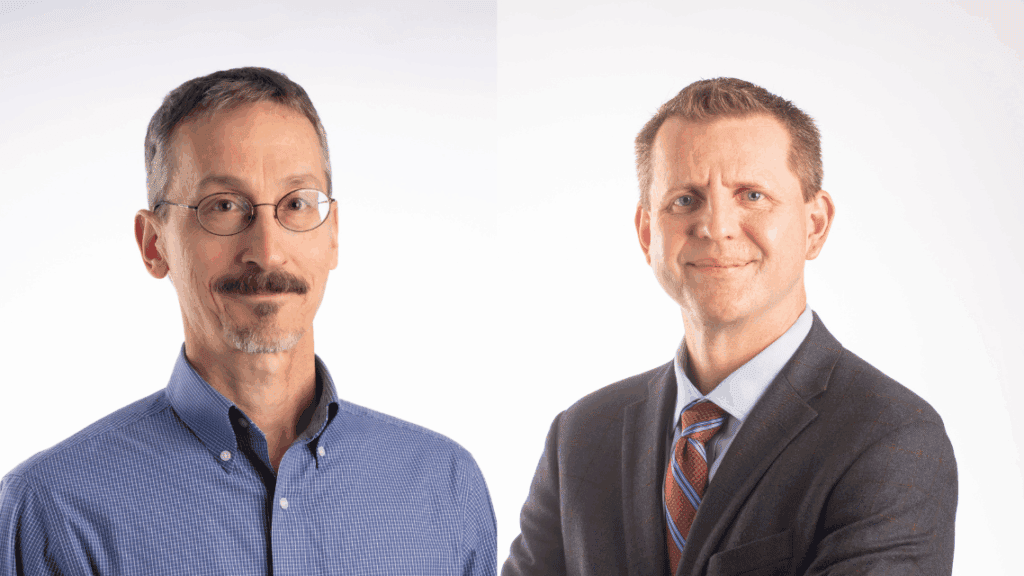
For more than three decades, Charles O’Brien, Ph.D., has helped shape skeletal biology research at UAMS. In this conversation with Alan Tackett, Ph.D., he reflects on his career, the evolution of skeletal biology research at UAMS, and the future of collaborative science.
Tackett: Tell us about your background and how you came to UAMS?
O’Brien: I’m from Oklahoma City and attended the University of Oklahoma. During graduate school at the OU Health Sciences Center, I worked in an autoimmune disease lab studying a small target called Ro/SSA. Then I moved to Yale for postdoctoral training in cell biology. I continued working on that same molecular complex, trying to better understand what it did. We made some progress, but even decades later scientists still don’t fully understand what it does.
At some point, I felt that I had taken that line of research as far as I could. An opportunity arose to join UAMS in 1994, shortly after the formation of what became known as “The Bone Group.” It was an exciting time to be part of something that was just beginning to grow.
Tackett: UAMS has a remarkable history in bone biology. How was that critical mass of bone biologists developed?
O’Brien: The foundation was laid when UAMS recruited a group of bone researchers from Indianapolis in 1993. The goal was to complement the strong myeloma program already established at UAMS. Among those recruits was Teresita Bellido, Ph.D., and that group expanded rapidly over the next several years to include some well-recognized skeletal biologists and osteoporosis physicians.
I was recruited to bring molecular biology expertise, particularly in creating genetically modified mouse models. Before long, we secured a program grant from the National Institutes of Aging, and that funded our work for nearly two decades.
The group’s strength was the diversity of skills, expertise, and perspectives everyone brought to the table: kind of like a team of superheroes. Everybody has a different superpower and alone they do pretty well. But when you put them all together, you’re able to do things you wouldn’t be able to do on your own. We were independent researchers but supported one another and were able to do this complementary work. I think that was a big reason we were successful.
Tackett: During that period, UAMS had major program grants in both skeletal biology and myeloma research, both extremely hard to obtain. What was the atmosphere like on campus during that time?
O’Brien: It was an exciting time. Both programs were highly productive and focused on important scientific questions. The focus of the bone group was understanding the major causes of osteoporosis, specifically postmenopausal osteoporosis, aging, and glucocorticoid-induced bone disease. For myeloma, all kinds of big breakthroughs were happening with new therapeutic options during that time.
Tackett: You mentioned superheroes. Your superpowers have helped establish you as a national and international leader in your field. I know you’re not one to brag about yourself or your science, but tell us about some of the key findings from your lab and the impact of those findings to the field.
O’Brien: I had developed some expertise in the basic tools of molecular biology. I was pretty good at the genetic tools — building pieces of DNA and studying gene expression. We had a lot of great in vitro tools at the time, but relatively few for studying these questions in living organisms.
The question my lab was focused on was a very simple one in skeletal biology. Bone is constantly turning over and being broken down by osteoclasts and rebuilt by osteoblasts. It’s a carefully controlled process. Under normal conditions, everything’s fine. You maintain bone mass. But when those two cell types get out of balance, bone loss occurs.
We wanted to understand what controls osteoclast formation, particularly in conditions like estrogen deficiency or glucocorticoid exposure. That work eventually led us to osteocytes, which are former osteoblasts embedded in the bone matrix. Scientists had known about osteocytes for more than a century, but their function was pretty murky until we discovered that they play a critical role in regulating osteoclast formation. That finding significantly changed how researchers think about bone remodeling and is the contribution from our lab that has had the greatest impact on the field.
Tackett: I know your program has been hugely successful and continuously funded. You’ve had great trainees come through and a stellar career at UAMS.
I want to go back and expand on the history. About a decade ago, we had this established research program in bone biology and a growing cadre of talented investigators. You’re doing well as a full professor by this time, and things are setting up well to apply for a NIH COBRE grant. These are transformative grants for states like Arkansas to develop a critical mass of researchers in a thematic area and build infrastructure around. Tell me how it all came to be at the beginning.
O’Brien: The timing was important. After our long-running program grant ran its course, we were looking for ways to keep the success going. Around that time, Stavros Mangolagas, M.D., Ph.D., together with Lowry Barnes, M.D., who was chair of orthopedic surgery at the time, approached UAMS leadership about growing musculoskeletal research capacity outside of endocrinology. Initially, we weren’t thinking about the COBRE mechanism, but Larry Cornett, Ph.D., who was vice chancellor for Research Innovation at the time, explained it to us and encouraged us to apply. We assembled a team, which included you as part of the advisory council, and were fortunate to get funded on the first submission. You hear the phrase game changer, but that’s not an exaggeration in how transformative it was.
Tackett: What impact has the COBRE had on faculty development and research infrastructure?
O’Brien: The COBRE amplified the initial institutional investment and gave those promising young investigators that Stavros and Lowry had recruited a meaningful start. We built several research cores to help the junior investigators in a very targeted way, including histology, imaging, and a bioinformatics core that researchers used to great effect. The outcomes speak for themselves. Three of our project leaders in the first five years secured R01- level funding and have since renewed it or gotten additional funding. It’s been wonderful that all four of our project leaders who graduated in that first phase are all still here. None of them took their first grant and left. So, it really helped build that critical mass of talented investigators focused on different aspects of skeletal biology.
Tackett: It’s a great example of exactly what a COBRE should do and the impact it can have. The partnership between endocrinology and orthopedics has been especially productive. Why was that relationship so important?
O’Brien: Lowry was on board from the very beginning. He created opportunities for talented scientists to establish careers in orthopedics, and that’s continued to grow.
One of the most important developments to emerge through those collaborations is the development of the Human Tissue Bank, where some of the tissue obtained during joint replacements can be used in the lab to explore questions we typically only look at in mice. There are many people involved in that process today, but a great deal of the credit belongs to Elena Ambrogini, M.D., Ph.D., one of our first project leaders to graduate with the VA Merit. She’s the driving force behind making that happen.
Tackett: I’m going to move on to a more recent announcement. You’re one of the recipients of a Razorback Research Catalyst Award. Tell me about the project, how it came to be, and where you all are going with it.
O’Brien: It’s a very exciting collaboration focused on the effects of GLP-1 receptor agonists on bone and muscle. These new medications have become increasingly common in treating diabetes and obesity, but there is real potential that they have some important side effects as well. There is some evidence — not a lot, but some — that these medications negatively impact bone and muscle. The project originated with Dr. Ambrogini, who is an endocrinologist and treats a lot of people with diabetes and obesity. She’s very familiar with these drugs and is concerned about their potential impact on the skeleton. And the person who knows the most about muscle is Nick Greene, Ph.D., professor and director of the Integrative Muscle Metabolism Lab at UA. Nick’s an exercise physiologist and a muscle biologist as well, and was really interested when Elena approached him about this idea. The team that we’ve assembled will examine what’s happening with the skeleton in people who are taking these drugs over time, and what’s happening to their skeletal muscle as well — not only their muscle mass, but also their muscle function.
Tackett: I think building collaborations across institutions in Arkansas is so important. Our respective campuses have all types of expertise that is so complementary, between the UAMS campus and the Fayetteville campus, and even at Arkansas Children’s and Arkansas State. Hopefully, this catalyst mechanism will fund additional cross-institutional collaborations.
O’Brien: It’s a great opportunity.
Tackett: Last question. I think what’s on the mind of many biomedical researchers is the funding climate. These things run in cycles, right? When I started here 20 years ago, I started in a valley when funding rates were low. If you look historically, there are going to be peaks when grant funding is more readily available and valleys when it’s not.
You’ve got young researchers trying to launch their labs. It’s tough right now. What advice would you give them?
O’Brien: It’s a difficult situation, and I don’t have all the answers. But it brings to mind something that happened to me when I first started my lab here more than 30 years ago. I ran into Kent Westbrook, M.D., in an elevator, and he asked, “So what have you discovered?” I fumbled my words and didn’t have a clear answer. I essentially said, “I really haven’t discovered anything.” He was nonplussed. After a minute, he recovered and said, “Then what are you doing here?” And he was absolutely right. He said that our job as scientists is discovery, and if we focus on that and do it well, we’re going to be okay in the long run. It’s going to be tougher sometimes than others. Right now, it’s a tough time. But focusing on the work and getting the job done is the most important thing, in my view.
Tackett: I agree. As researchers, we have to step back, look at what we’re doing, and focus on something that’s going to be impactful, translational, and exciting to us. Then we put our heads down and work to get it done. We will get out of this valley, and things will be better in a few years. It’s just weathering the storm. We have a great environment at UAMS, strong support, and outstanding collaborators in the College of Medicine and across UAMS.
Tackett: Charles, thank you for sharing your story and for everything you’ve done to advance research at UAMS.
O’Brien: Thank you, Alan. I appreciate it.