• Skip to main content
  • Skip to main content
Choose which site to search.
University of Arkansas for Medical Sciences Logo University of Arkansas for Medical Sciences
College of Medicine: Department of Biochemistry and Molecular Biology
  • UAMS Health
  • Jobs
  • Giving
  • About Us
    • News
  • Faculty/Staff
    • Primary Faculty
    • Secondary Faculty
    • Adjunct Faculty
    • Professor Emeritus
    • Track Members
    • Research and Administrative Staff
  • Research Areas
    • Cancer Biology
    • Experimental Therapeutics
    • Systems Biology and Bioinformatics
      • Systems Biology News
    • Structural Biology and Enzymology
    • Nutrition and Metabolism
    • Chromatin Biology, Nucleic Acid Chemistry, and Genetics
    • Neurobiology and Neurobiochemistry
  • Students
    • Graduate Program
    • Elective Courses
    • Student Highlight
    • Alumni
      • Graduates
      • Where Are They Now?
    • Grant Opportunities
    • Career Information
    • Resources for Current Students
    • Resilience
    • About the Area
  • Seminars
    • Faculty Seminars
    • Student Seminars
    • Webinars and Conferences
  • Undergraduate Programs
    • Summer Research
      • Program Details
      • Application Materials
      • Research Opportunities
      • Information for Participants
      • Prior Participants
      • SURF Related Publications
      • Contact Information
      • Frequently Asked Questions
    • Arkansas Undergraduate Summer Research Symposium
      • Details
      • Registration
      • Directions and Parking
      • Top Presentations
      • Contact
  • Research Resources
  1. University of Arkansas for Medical Sciences
  2. College of Medicine
  3. Department of Biochemistry and Molecular Biology
  4. Department News
  5. Page 2

Department News

UAMS M.D./Ph.D. Student Receives Fellowship Award from National Cancer Institute

Picture of Sydnye Shuttleworth sitting at the lab bench.
UAMS College of Medicine student Sydnye Shuttleworth will continue her pursuit to become a physician and cancer researcher with support from a National Cancer Institute fellowship.  Image by Jaison Sterling

By Tamara Robinson

Aug. 1, 2025 | Sydnye Shuttleworth, a student in the University of Arkansas for Medical Sciences (UAMS) College of Medicine and an affiliate trainee member of the Winthrop P. Rockefeller Cancer Institute, has been awarded a prestigious fellowship award for aspiring physician-scientists from the National Institutes of Health (NIH) National Cancer Institute (NCI).

Shuttleworth, who is pursuing a doctoral degree in the UAMS Graduate School in addition to a medical degree, is the first M.D./Ph.D. student at UAMS to receive the highly competitive Ruth L. Kirschstein National Research Service Award (NRSA) from the NCI. She joins an elite group across the country and a small group from UAMS who have received NRSA awards from one of the NIH institutes.

The $189,128 award, referred to as an F30 NRSA fellowship, provides four years of funding for Shuttleworth’s tuition, a stipend and an institutional allowance to support her research training.

“Ms. Shuttleworth’s NRSA fellowship is focused on the rapidly expanding field of engineering immune cells to be more effective and efficient at eliminating cancer cells, particularly those in solid tumors,” said Alan Tackett, Ph.D., deputy director of the UAMS Winthrop P. Rockefeller Cancer Institute and executive associate dean for basic research in the UAMS College of Medicine. “This specific area of research has the potential to transform how we utilize immunotherapies to treat patients with cancer.”

“Sydnye is one of those trainees who just doesn’t let up — in the best way,” said Shuttleworth’s mentor, Brian Koss, Ph.D., an assistant professor in the Department of Biochemistry and Molecular Biology. “She is driven, deeply committed, and always thinking about how her work can make a real impact. That kind of focus is exactly what you want in a future physician-scientist, and it’s no surprise she has already earned competitive funding to support her research. She raises the bar for everyone around her, including me.”

Read more about Sydnye.

Filed Under: Department News

July 2025 publications

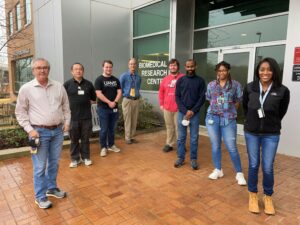
Picture of members of the Byrd lab

Untargeted CUT&Tag reads are enriched at accessible chromatin and restrict identification of potential G4-forming sequences in G4-targeted CUT&Tag experiments.
Thompson MD, Byrd AK.
Nucleic Acids Res. 2025


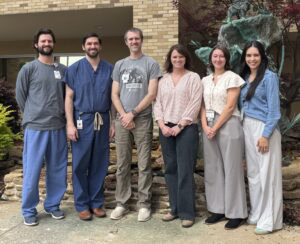
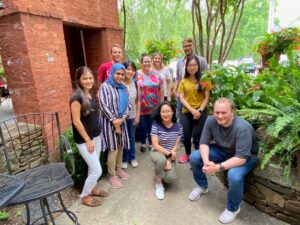
Picture of Kendrick lab members on a patio

G-quadruplex and i-motif DNA structures form in the promoter of the key innate immune adaptor MYD88.
Brown S, Swafford K, McCrury M, Nasrin F, Gragg CQ, Chavan A, Roy Choudhury S, Dickerhoff J, Yang D, Kendrick S.
Cell Rep Phys Sci. 2025


Alicja Urbaniak, Alan Tackett, and Billie Heflin

Monensin and Its Analogs Exhibit Activity Against Breast Cancer Stem-Like Cells in an Organoid Model.
Urbaniak A, Heflin B, Siegel E, Reed MR, Nix JS, Yee EU, Jędrzejczyk M, Klejborowska G, Stępczyńska N, Huczyński A, Nagalo MB, Chambers TC, Post S, Eoff RL, MacNicol MC, Tiwari AK, Kelly T, Tackett AJ, MacNicol AM.
bioRxiv [Preprint]. 2025


Dan Dixon

The XPO1 Inhibitor Eltanexor Modulates the Wnt/β-Catenin Signaling Pathway to Reduce Colorectal Cancer Tumorigenesis.
Evans AE, Afroz S, Magstadt A, Kasi A, Dixon DA.
Cancer Res Commun. 2025

Filed Under: Department News

June 2025 Publications

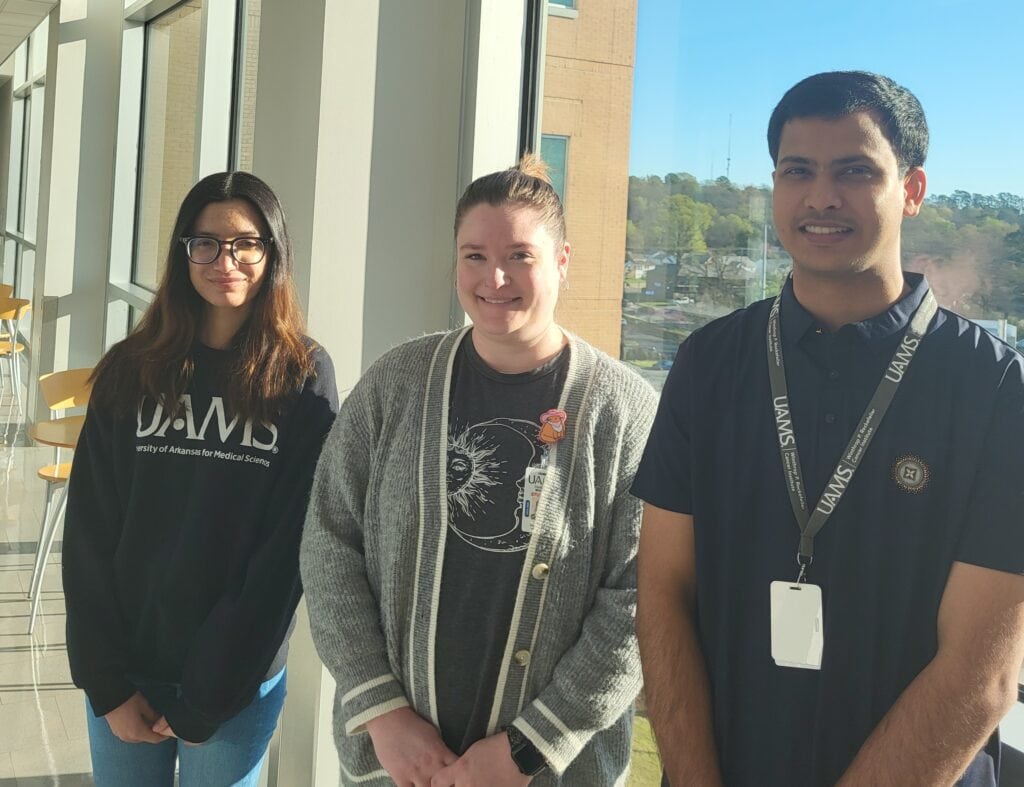
Picture of members of the Koss lab

EZH2 loss during metabolic stress drives restoration of MHC class I machinery in melanoma.
Edmondson JL, Reed MR, Fil D, Heflin B, McKinnon A, Bauer MA, Morehead LC, Avaritt NL, Phillips M, Taverna SD, Tackett AJ, Koss B.
iScience. 2025

Filed Under: Department News

Congratulations to Dr. Matthew Thompson

Picture of Matthew Thompson, Ph.D. in his graduation gown standing in front of a DNA sculpture

Congratulations to Matthew Thompson, Ph.D., on his successful defense of his dissertation entitled, “DNA Helicase B (HELB) and DNA secondary structures at the DNA replication fork.” Dr. Thompson was mentored by Alicia Byrd, Ph.D. He will be an Assistant Professor of Chemistry at Lyon College this fall.

Filed Under: Department News

GSA Honors

We’re excited to share highlights from the recent Graduate Student Association (GSA) Closing Ceremony, where several outstanding graduate students and staff members were honored for their leadership and dedication:

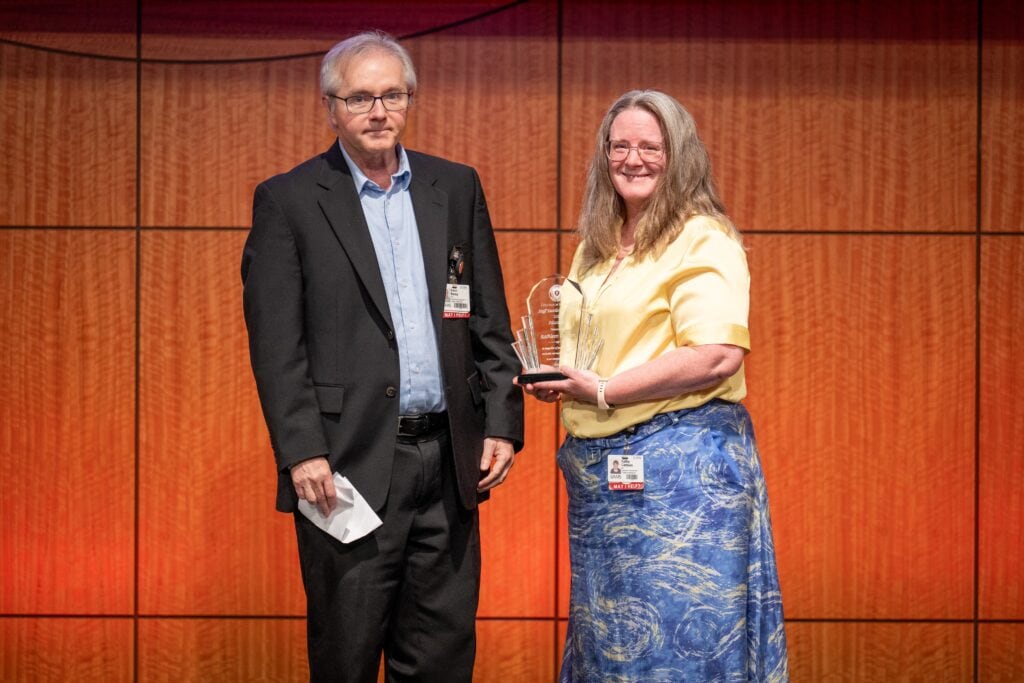
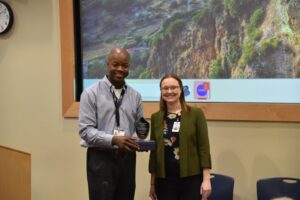
Mrs. Kathy Carlson, Education Coordinator, received the Legacy of Service Award in recognition of her long-standing commitment and unwavering support of the Graduate Student Association (GSA) .

Reham Sewilam, fourth-year Ph.D. student and GSA President, received both the Visionary Leadership Award and the Change Maker Award for her pioneering efforts and exceptional leadership in creating new initiatives to support graduate students at UAMS in both educational and non-educational levels.

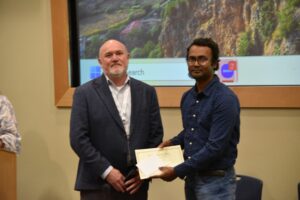
Lokesh Akana, third-year Ph.D. student and GSA Treasurer, was honored with the Heart and Hustle Award for his enthusiastic contributions and dedication to the GSA mission.

Sanjay Adhikary, second-year Ph.D. student and GSA Secretary, received the Exemplary Service Award for his growing contributions and active involvement in the GSA mission.

Congratulations to all awardees for their incredible work and commitment to the graduate student community!

Kathy and Reham – Legacy of Service Award
Lokesh and Reham – Hearts and Hustle Award
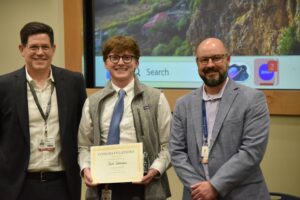
Dr. Taverna and Reham – Visionary Leadership
Lokesh and Reham – Changemaker
Sanjay and Reham – Exemplary Service Award

Filed Under: Department News, Student Highlights

May 2025 Publications

Picture of members of the Byrd lab

Rare SNP in the HELB gene interferes with RPA interaction and cellular function of HELB.
Osei B, May BH, Beard JS, Thompson MD, Alkam D, Zafar MK, Bergstrom E, Byrum SD, Enemark EJ, West KL, Byrd AK.
NAR Mol Med. 2025


Eric Enemark, Ph.D.

Structure of the Saccharolobus solfataricus GINS tetramer.
Shankar S, Enemark EJ.
Acta Crystallogr F Struct Biol Commun. 2025


Members of the Raney lab

A post-assembly conformational change makes the SARS-CoV-2 polymerase elongation-competent.
Klein M, Das A, Bera SC, Anderson TK, Kocincova D, Lee HW, Wang B, Papini FS, Marecki JC, Arnold JJ, Cameron CE, Raney KD, Artsimovitch I, Götte M, Kirchdoerfer RN, Depken M, Dulin D.
Nucleic Acids Res. 2025


Kim Stephens, Ph.D.

Stress During Lactation: A Hidden Link to Offspring Bone Health.
Chandrashekar R, Mulakala BK, Gurung M, Venna G, Rearick JR, Onyekweli B, Ruebel ML, Dada-Fox J, Zeledon JA, Talatala R, Rodriguez K, Osborn LR, Bishop MG, Smith B, Stephens KE, Lucas EA, Yeruva L.
Calcif Tissue Int. 2025


Members of the Raney lab

Biomolecular condensates control and are defined by RNA-RNA interactions that arise in viral replication.
Aierken D, Zhang V, Sealfon R, Marecki JC, Raney KD, Gladfelter AS, Joseph JA, Roden CA.
Res Sq [Preprint]. 2025

Filed Under: Department News

Thomas Williams Wins Poster Award

Thomas Williams presenting his poster to a group of people.
Thomas Williams presenting his poster

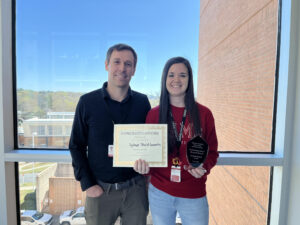
Congratulations to Thomas Williams for winning the award for the best graduate student poster at the Winthrop P. Rockefeller Cancer Institute Retreat. Thomas’ poster was entitled, “Defining the role for PCK2 i T-cell metabolic plasticity in the solid tumor microenvironment” Thomas is a first year graduate student in the lab of Brian Koss, Ph.D.

Picture of Brian Koss and Thomas Williams with Thomas' award
Thomas with his mentor, Brian Koss.

Filed Under: Department News

Congratulations to Dr. Jake Edmondson

Picture of Jake Edmondson in a white coat

Congratulations to Jake Edmondson, Ph.D., on his successful defense of his dissertation entitled, “Enhancing the cancer immunotherapy response through mechanisms of epigenetic control and endoplasmic reticulum stress.” Dr. Edmondson was mentored by Alan Tackett, Ph.D., and Brian Koss, Ph.D. He is an M.D./Ph.D. student who will return to medical school this summer.

Filed Under: Department News

April 2025 Publications

Isabelle Racine Miousse

GLP-1 receptor agonists in the context of cancer: the road ahead.
Miousse IR.
Am J Physiol Cell Physiol. 2025


Picture of members of the Moldoveanu lab

Structural basis of BAK sequestration by MCL-1 in apoptosis.
Srivastava S, Sekar G, Ojoawo A, Aggarwal A, Ferreira E, Uchikawa E, Yang M, Grace CR, Dey R, Lin YL, Guibao CD, Jayaraman S, Mukherjee S, Kossiakoff AA, Dong B, Myasnikov A, Moldoveanu T.
Mol Cell. 2025

Filed Under: Department News

UAMS Winthrop P. Rockefeller Cancer Institute Scientists Uncover New Opportunities for Targeted Cancer Therapies

Picture of members of the Moldoveanu lab
A team of scientists led by Tudor Moldoveanu, Ph.D., has uncovered new insights into the body’s natural process of cell death that impacts the development of cancer. Dr. Moldoveanu’s Lab includes Shagun Srivastava, MSc, research associate, Elisabeth Ferreira, Ph.D., associate scientist, and Raja Dey, Ph.D., principal scientist. Image by Evan Lewis

By Marty Trieschmann

April 22, 2025 | Molecular Cell publishes UAMS comprehensive structural biology study of MCL-1:BAK complex found in most cancers

A research team led by UAMS Winthrop P. Rockefeller Cancer Institute scientist, Tudor Moldoveanu, Ph.D., has uncovered novel insights into one of the body’s most fundamental processes impacting the development of cancer. Known as apoptosis, the research on the process of programmed cell death was published April 4 in the high-impact journal Molecular Cell.

“At a high level, our research tackles a central mechanism of cell death known as apoptosis,” said Moldoveanu, an associate professor in the UAMS College of Medicine Department of Biochemistry and Molecular Biology and co-leader of the Cancer Institute’s Cancer Therapeutics Research Program.

“Apoptosis is a fundamental biological process that supports our health,” he said. “Our bodies need to get rid of cells that are too old or damaged to work properly. If those cells keep hanging around, they can harm us and lead to cancer and other conditions.”

Moldoveanu’s study focuses on the protein complex MCL-1:BAK which blocks apoptosis when formed and is a common target for drug makers.

“There are four other known proteins similar to MCL-1 that inhibit apoptotic cell death that we know of, and MCL-1 is one of the worst that shows up in a lot of cancers,” Moldoveanu said. “It’s one of the most upregulated proteins in cancer that makes it harder for cell death to happen and is a proven recipe for growing tumors in cancer.”

In multiple myeloma, MCL-1 is responsible for more than 40% of new cases and more than 70% of relapsed, refractory cases. BAK is a pro-death protein that initiates apoptosis when activated by cancer therapies and often interacts with MCL-1 blocking its pro-apoptotic role.

For the first time, drug makers now have an atomic level view of the MCL-1:BAK protein complex. Moldoveanu’s team used an integrated structural biology approach with nuclear magnetic resonance (NMR) spectroscopy, cryo-electron microscopy (cryo-EM) and X-ray crystallography, to provide the most detailed characterization of the molecular structure of the complex to date.

After testing select highly potent drugs designed to inhibit MCL-1 in a reconstituted MCL-1:BAK complex in the lab, the results surprised even Moldoveanu.

“One of the most surprising findings is that MCL-1 inhibitors are not very good in neutralizing the MCL-1:BAK complex, requiring high doses to initiate cell death. Our study underscores the need to design superior MCL-1 inhibitors.”

Moldoveanu is the lead author of the study between his lab in the UAMS Department of Biochemistry and Molecular Biology and collaborators at St. Jude Children’s Research Hospital, the University of Chicago, the University of Arkansas in Fayetteville and École Polytechnique Fédérale de Lausanne.

“Among the cancer therapies available to us, we have very few inhibitors to regulate cell death in patients with cancer,” Moldoveanu said.

“The problem is that current inhibitors targeting MCL-1 also impact organs and tissues, such the heart and cells that line the blood vessels,” he added. “These cells are highly susceptible to toxicity from cancer chemotherapy in general, so the issue is how to administer MCL-1 inhibitors to initiate cell death safely and in a more targeted way that doesn’t go everywhere in the body.

“Now that we have a better view of how this complex looks and forms and that these drugs are not as effective as we imagined, we can move forward with designing future therapies to have better potency and bioavailability in neutralizing this pathway,” said Moldoveanu.

Filed Under: Department News

  • «Previous Page
  • Page 1
  • Page 2
  • Page 3
  • Page 4
  • Interim pages omitted …
  • Page 33
  • Next Page»
UAMS College of Medicine LogoUAMS College of MedicineUniversity of Arkansas for Medical Sciences
Mailing Address: 4301 West Markham Street, Little Rock, AR 72205
Phone: (501) 686-7000
  • Facebook
  • X
  • Instagram
  • YouTube
  • LinkedIn
  • Pinterest
  • Disclaimer
  • Terms of Use
  • Privacy Statement
  • Legal Notices

© 2026 University of Arkansas for Medical Sciences