
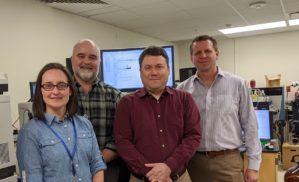
Congratulations to Aaron Storey and his co-authors on their publication featured on the August 2020 cover of Molecular Omics. The project was a collaboration between multiple labs and the proteomics and bioinformatics core facilities lead by Stephanie Byrum.
Department News
Alan Tackett receives $10.6 Million Grant to Expand National Proteomics Resource at UAMS
A $10.6 million grant from the National Institutes of Health (NIH) will allow the University of Arkansas for Medical Sciences (UAMS) to greatly expand its proteomics resource. This grant will establish the IDeA National Resource for Quantitative Proteomics as the first NIH National Resource in Arkansas, which will serve biomedical researchers across the nation.
Proteomics is the large-scale study of proteins that can lead to the development of new therapies and screening approaches for many diseases, including cancer.
The five-year grant was awarded to Alan Tackett, Ph.D., professor in the Department of Biochemistry and Molecular Biology and associate director for basic science at the UAMS Winthrop P. Rockefeller Cancer Institute. Tackett serves as an administrative director of this new national resource.
Other key contributors at UAMS are Rick Edmondson, Ph.D.; Samuel Mackintosh, Ph.D.; and Stephanie Byrum, Ph.D.; as well as Michael Kinter, Ph.D., at the Oklahoma Medical Research Foundation who serves as a co-administrative director.
The national resource was initially created through the Arkansas INBRE (IDeA Network of Biomedical Research Excellence) — an NIH program that promotes biomedical research for undergraduate students and faculty. Lawrence Cornett, Ph.D., professor in the UAMS College of Medicine Department of Physiology and Biophysics, serves as principal investigator and director of Arkansas INBRE.
“With this new funding, we will transition our proteomics resource to an NIH National Resource and expand our ability to provide highly advanced research support to scientists in underfunded areas throughout the United States,” said Tackett, who holds the Scharlau Family Endowed Chair for Cancer Research at UAMS.
Certain regions of the United States, designated as the IDeA Network, have historically received low levels of research funding from NIH. Scientists in these regions face challenges for accessing state-of-the-art proteomics resources.
The IDeA National Resource for Quantitative Proteomics at UAMS was established to address these gaps in services.
“Due to a lack of federal funding, it is often difficult for scientists in the IDeA Network to access the advanced instruments and trained personnel needed to analyze and interpret their research data. With this new funding, we will now be able to serve a diverse group of IDeA investigators for their research, which ranges from studies on model organisms to diseases such as cancer,” said Tackett, professor of biochemistry and molecular biology in the UAMS College of Medicine.
The expanded national resource will support researchers by providing highly advanced data analysis, outreach opportunities and education to scientists across the nation.
“Our goal is to increase the ability for scientists in the 23 IDeA states and Puerto Rico, as well as other NIH-supported investigators across the nation, to perform innovative research by providing unmatched access to advanced quantitative proteomics platforms and staff skilled in interpreting and analyzing complex biological data,” Tackett said.
The educational opportunities offered by the national resource include workshops that are designed to help faculty and student researchers across the nation better utilize proteomics in their research.
This federal grant will bolster the Cancer Institute’s ongoing efforts to receive National Cancer Institute Designation. To achieve designation, cancer centers undergo a highly competitive assessment process that demonstrates an outstanding depth and breadth of research in three areas: basic laboratory, patient/clinical and population-based. The designation brings with it many benefits, including expanded access to federal funding for researchers and improved access to clinical trials for patients.
Cancer Institute Member Spotlight — Alan Diekman, Ph.D.
Professor
Department of Biochemistry and Molecular Biology
Department of Urology
UAMS College of Medicine
Research Interest Statement
Research in the Diekman laboratory focuses on galectin-3, a carbohydrate-binding protein, in cancer and normal male reproductive function. Galectin-3 is implicated in the progression of multiple cancers, including prostate and breast cancer. Previously, we investigated the interactions of galectin-3 with prostate specific antigen (PSA), which is mainly known as a screening marker for prostate cancer. PSA is a serine protease that is secreted into semen where it functions as a proteolytic enzyme. PSA function during local and metastatic prostate cancer has also been proposed. We were the first to demonstrate that galectin-3 is a proteolytic substrate for PSA and investigated the function regulation of galectin-3 by PSA. We developed a novel strategy to purify PSA for these studies. Significantly, polymorphisms (SNP) in the coding region of the human galectin-3 gene create amino acid polymorphisms in the galectin-3 protein, and genotype analysis indicated that these SNPs are associated with increased odds of prostate cancer. We currently are investigating the impact of these amino acid polymorphisms on the molecular function of galectin-3. We anticipate that elucidation of the functional aspects of galectin-3 phenotypic variation relevant to disease etiology and pathology will contribute to development of individualized, precision medicine strategies to improve cancer prevention and treatment.
Dr. Diekman’s Cancer-related Grants
UAMS Executive Breast Committee: AWD00051704
Alan Diekman: PI
Title “Galectin-3 Genetic and Phenotypic Polymorphism in Breast Cancer”
09/1/2016 – 08/31/2020
$75,000*
*cancer-related direct cost
Dr. Diekman’s UAMS Collaborators
- Alicia Byrd, Ph.D., Department of Biochemistry and Molecular Biology, College of Medicine
- Joseph Su, Ph.D., M.P.H., Department of Epidemiology, College of Public Health
Opportunities for Collaboration
I have expertise in biochemistry, reproductive biology and glycobiology and am always interested in collaborating with colleagues. My research is focused on the role of carbohydrate-binding proteins in prostate cancer, but my interests extend to other cancers, including breast and colorectal cancer.
You May Not Know That …
I am the proud owner of a 1923 arts and crafts airplane bungalow in Hillcrest, but something always needs to be fixed. My hobbies include physical fitness, science fiction and annoying my children with dad jokes.
Recent Cancer-related Publications
- Saraswati, S., Block, A.S., Davidson, M.K., Rank, R.G., Mahadevan, M., Diekman A.B. (2011) Galectin-3 is a substrate for prostate specific antigen (PSA) in human seminal plasma. The Prostate 71:197-208, DOI: 10.1002/pros.21236. PMCID: PMC3606048.
- Kovak M.R., Saraswati S., Goddard, S., Diekman A.B. (2013) Proteomic identification of galectin-3 binding ligands and characterization of galectin-3 proteolytic cleavage in human prostasomes. Andrology 1:682-691, PMCID: PMC4180284.
- Bailey, L.A., Jamshidi-Parsian A., Patel T., Koonce N.A., Diekman A.B., Cifarelli .P., Marples B., Griffin R.J.: (2015) Combined temozolomide and ionizing radiation induces galectin-1 and galectin-3 expression in a model of human glioma. Tumor Microenvironment and Therapy 2:19-31.
Dr. Tackett appointed to NIH study section
Dr. Alan Tackett, Professor of Biochemistry and Molecular Biology, has been invited to serve as a standing member of the NIH Mechanisms of Cancer Therapeutics-1 (MCT1) Study Section, one of the major review boards for evaluation of cancer research by the Center for Scientific Review. The four-year appointment recognizes Dr. Tackett, who also serves as the Scharlau Family Endowed Chair in Cancer Research at UAMS, as a leader in this field. Congratulations to Dr. Tackett.
July publications
Neonatal Diet Impacts Circulatory miRNA Profile in a Porcine Model.
Carr LE, Bowlin AK, Elolimy AA, Byrum SD, Washam CL, Randolph CE, MacLeod SL, Yeruva L.
Front Immunol. 2020
Screen identifies DYRK1B network as mediator of transcription repression on damaged chromatin.
Dong C, West KL, Tan XY, Li J, Ishibashi T, Yu CH, Sy SMH,Leung JWC, Huen MSY.
Proc Natl Acad Sci 2020
Novel advances in biotransformation and bioactivation research-2019 year in review.
Khojasteh SC, Driscoll JP, Jackson KD, Miller GP, Mitra K, Rietjens IMCM, Zhang D.
Drug Metab Rev. 2020
Dr. Miller Appointed to NIH Study Section
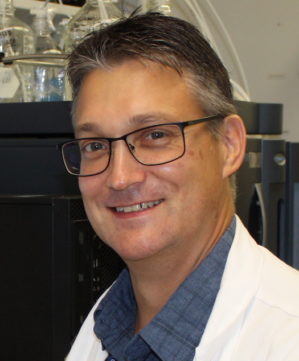
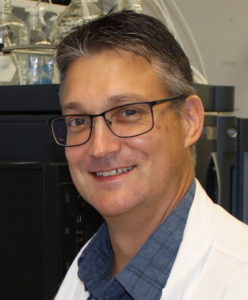 Congratulations to Dr. Grover Miller, Professor of Biochemistry and Molecular Biology, on his appointment to the Xenobiotic and Nutrient Disposition and Action (XNDA) Study Section in the National Institutes of Health’s Center for Scientific Review. Dr. Miller will serve a four-year term on the panel, whose members are selected for their excellence and achievement in their scientific discipline. At UAMS, Dr. Miller and his team develop and apply new and powerful strategies to better assess drug liabilities that cause significant adverse drug events including cardio- and hepato-toxicity.
On the cover
Congratulations to postdoctoral fellow Maroof Zafar and his co-authors, Lindsey Hazeslip, Zain Chauhan, and Alicia Byrd. Cover art by Lindsey Hazeslip for their recent article on regulation of expression by non-canonical G-quadruplexes was selected for the cover of the July 2020 issue of Biochemistry.
June publications

Wongsurawat T, Jenjaroenpun P, De Loose A, Alkam D, Ussery DW, Nookaew I, Leung YK, Ho SM, Day JD, Rodriguez A.
Acta Neuropathol Commun. 2020
 The Expression of Human DNA Helicase B Is Affected by G-Quadruplexes in the Promoter.
Zafar MK, Hazeslip L, Chauhan MZ, Byrd AK.
Biochemistry. 2020
Findings on DNA Damage Repair Published by UAMS Cancer Researcher
By Susan Van Dusen
LITTLE ROCK — A research team led by cancer researcher Justin Leung, Ph.D., at the University of Arkansas for Medical Sciences (UAMS) has uncovered the role of the protein RNF168 in DNA damage repair and shown how mutations of the protein affect people with a rare genetic condition.
The study titled “Histone H2A variants alpha1-extension helix directs RNF168-mediated ubiquitination” was published in the May 18 issue of the open-access journal Nature Communications.
“Every day our cells are subjected to environmental sources of DNA damage, such as ultraviolet radiation and toxic chemical exposure. If left unrepaired, these damages can accumulate, leaving mutations in our DNA and ultimately cause cells to become cancerous,” said Leung, assistant professor in the UAMS College of Medicine Department of Radiation Oncology.
In most cases, this damage is detected and repaired by a tightly regulated method involving many proteins. To develop better cancer therapies, researchers such as Leung strive to understand the regulation of DNA damage and repair by sensitizing cells to radiation therapy and chemotherapy drugs that target DNA.
“Our lab studies the repair of double stranded breaks, where both strands of DNA are broken apart completely. When a double strand break occurs, a cascade of protein activity is set off to try to resolve the damage,” Leung said.
Mutations in one of these proteins, RNF168, have been found in patients with RIDDLE syndrome, a rare genetic disorder that increases a person’s predisposition to blood cancer and is characterized by several attributes:
- Susceptibility to DNA damaging agents
- Immunodeficiency, or failure of the immune system to protect the body from infection
- Developmental abnormalities
- Learning disabilities
RNF168 adds a small signaling molecule called ubiquitin onto a subunit of chromatin, where we store our genetic information. The ubiquitin signal brings repair proteins to DNA double strand breaks. However, exactly how RNF168 recognizes the specific target remains unclear.
Using molecular and structural analysis methods, Leung’s team uncovered crucial components of RNF168 and chromatin required for the implementation of repair pathways in response to DNA damage. Their findings suggest that a recognition between RNF168 and chromatin is required to activate the downstream DNA repair processes.
“RNF168 is a central DNA damage response protein. Understanding the precise mechanisms by which it activates its targets is essential for understanding how the DNA damage response goes awry. Our results help demystify the role of RNF168 in proper DNA damage repair and understand the implications of RNF168 mutations such as those seen in RIDDLE syndrome,” Leung said.
UAMS authors for this study included Jessica Kelliher, B.S., research assistant, and Kirk West, Ph.D., postdoctoral fellow.
Alan Diekman receives Master Teacher Award from the College of Medicine
Alan Diekman, Ph.D., was honored as the 2020 Master Teacher in recognition of his work with first-year medical students. When College of Medicine students are asked about their best teachers, Diekman’s name comes up often. As director of the Molecules to Cells course, Diekman teaches first-year students and works with other faculty to ensure the students gain a firm grasp of biochemistry, cell biology and genetics – including complex concepts that many medical students nationwide struggle to grasp.
“Most importantly, he has convinced students that understanding molecular and cellular mechanisms is an important part of their medical training,” Department of Physiology and Biophysics Chair Michael Jennings, Ph.D., wrote in a letter of support for Diekman, who has served on the faculty since 2002.
“The word ‘outstanding’ may underestimate the quality of Dr. Diekman’s teaching effort, ability and outcomes,” Biochemistry and Molecular Biology Chair Kevin Raney, Ph.D., wrote in his nomination letter. “He is a superb communicator who treats students respectfully, while maintaining high expectations. Dr. Diekman also sets high standards for his colleagues, thereby improving the quality of teaching of those around him.”
James Graham, M.D., executive associate dean for academic affairs in the college, also wrote in support, noting strong performance by UAMS students in areas of the notoriously difficult United States Medical Licensing Exam Step 1 that are covered in Diekman’s course, as well as improved overall performance on the exam in recent years. Diekman has been instrumental in major curriculum revisions that change how first- and second-year medical students prepare for their clinically focused training.
“I am very honored by this recognition from my colleagues, and I thank them for their past support,” said Diekman. “The privilege of educating our medical students in the complex disciplines of biochemistry, cell biology and genetics is both challenging and fulfilling. My goal is to provide our students with a firm foundation in these disciplines, not just for their sake, but also for that of their future patients.”