
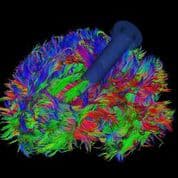
A recent evolution in neurosurgical technologies has led to a way to treat the most serious kinds of brain tumors and stroke while preserving brain function, which was previously thought impossible. J.D. Day, MD, Chairman of the UAMS Department of Neurosurgery, is the first neurosurgeon in the state of Arkansas to use the BrainPath® technology.
This cutting edge technology uses a BrainPath® tube, advanced imaging of tracts in the brain and a computerized brain navigation system, which allows physicians to navigate the brain with unprecedented clarity to target and suction out deep-seated brain tumors, abscesses and hemorrhages with much less disruption of tissue than with traditional techniques. While individual technologies have been available for more than a decade, they have primarily been used independent of one another. Neurosurgery has now evolved to reach the Final Frontier by using the new 6 Pillar Approach.The BrainPath® is part of the 6 Pillar Approach that uses several advanced technologies. The Pillars of the approach include: brain imaging, neuro-navigation, access, high-definition optics, resection (removal) of the abnormality, and tissue collection for regenerative medicine options.

“The procedure is the closest that we can get to a precisely targeted, flawless surgery for deep brain tumors,” Dr. Day said. “We are able to get to tumors in a much safer way that will put patients at less risk of brain damage and will preserve critical brain structures and tracts.” The many benefits of the breakthrough procedure, which creates a small, dime-sized channel through the brain, include a faster recovery time, minimal internal and external scarring, less trauma to the brain and nerves, and few side effects and complications post surgery. The procedure trumps traditional open surgery because a limited opening is created to access deep in the brain, so less of the brain is exposed, and the brain tissue is minimally disrupted.
What conditions can BrainPath® treat?
- Glioblastoma multiforme (GBM), the most common and deadly type of malignant brain tumor
- Other primary brain tumors and cysts
- Metastatic brain tumors, secondary tumors that occur elsewhere in the body and migrate to the brain
- Intracerebral hemorrhage or hemorrhagic stroke
- Hemorrhage from traumatic brain injury
Please call the UAMS Department of Neurosurgery 501-686-5270 to see if this cutting edge-technology is right for your patients.