• Skip to primary navigation
  • Skip to main content
  • Skip to primary navigation
  • Skip to main content
Choose which site to search.
University of Arkansas for Medical Sciences Logo University of Arkansas for Medical Sciences
College of Medicine
  • UAMS Health
  • Jobs
  • Giving
  • About Us
    • Fast Facts
    • Leadership
    • Features
    • COMmunication Newsletter
    • Maps and Directions
    • College of Medicine History
    • Professionalism Guidelines
  • Departments
  • Admissions
    • New Admissions Standards 2026
    • Applicant Guide and Timeline
    • One Medical School, Two Campuses
    • Freshman Scholarships
    • AMCAS Choose Your Medical School Tool Dates
    • Core Competencies for Entering Medical Students
    • Three-Year M.D. Program
    • M.D./MPH Program
    • M.D./Ph.D. Program
    • M.D./MBA Program
    • Rural Practice Programs
      • Community Match Rural Physician Recruitment Program
      • Rural Practice Scholarship Program
      • Rural Recruitment and Job Opportunities
    • Postbaccalaureate Pre-Med Program
    • Transfer Students Policy
  • Students
    • Academic Calendar
    • Academic Houses
    • Career Advising
    • Financial Aid and Scholarships
    • Visiting Students
    • Mentor Spotlight Podcast
    • Preparing for Residency
    • Non-Discrimination Statement
    • Outstanding Teacher Nominations
    • Parents Club
    • Student Links
    • Honors in Research
    • UAMS Campus Security
    • Undergraduate Medical Education Competencies
  • Graduate Medical Education
  • Alumni
  • Faculty Affairs
  • Research
  1. University of Arkansas for Medical Sciences
  2. College of Medicine
  3. UAMS Researchers, Students, Urged to Become Science Advocates

UAMS Researchers, Students, Urged to Become Science Advocates

Oct. 4, 2017 | By being effective advocates for science funding, researchers can help the U.S. lead the world in science and help their own careers, UAMS students and faculty were told at a recent lecture.

“The public does not understand what we do and they don’t understand why we do it,” said Richard L. Eckert, Ph.D., from the University of Maryland, School of Medicine, where he is a professor and chair of the Department of Biochemistry and Molecular Biology.

The Sept. 27 lecture was sponsored by the Office of Interprofessional Education and the College of Medicine Department of Biochemistry and Molecular Biology.
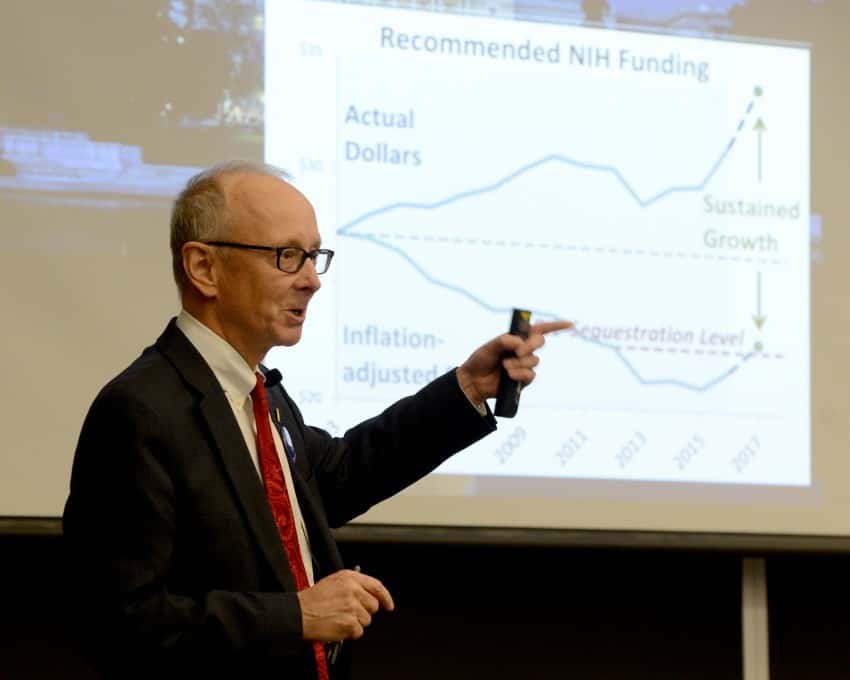
Richard L. Eckert, Ph.D. speaking
Richard L. Eckert, Ph.D., said funding for the National Institutes of Health (NIH) remains below 2003 levels in inflation-adjusted dollars.

Knowing how to talk to nonscientists about the importance of research is an important skill for researchers, Eckert said.  “Leave out the calcium concentrations. Tell the big picture.”

Whether talking to family or friends at a party, the importance of science and the threats to funding must be communicated clearly.

He noted that the U.S. share of worldwide research and development has fallen in recent years from 35 to 27 percent, while Asia’s share has climbed from 27 to 40 percent.

The good news is that Congress has started to increase funding for research, but current funding levels for the National Institutes of Health (NIH) remain below 2003 levels in inflation-adjusted dollars.

Funding stability is especially critical in science, he said, because a sudden cut in funding such as occurred in 2013 can sabotage years invested in science programs.

“This will be very important to your careers because you’re going to be funded by the federal government to do research, and you’ll want to pursue your work,” Eckert said.  “Very few Americans know what the NIH is, and that’s why you have to make an effort to tell them.”

Eckert leads delegations of researchers to Capitol Hill in Washington D.C. to speak directly to members of the House and Senate.

“In the years to come you’re going to have to increasingly engage with this kind of activity because lots of people are asking for support from government and sometimes budgets are limited so we have to be there and we have to lobby with our congressmen and senators to do things that are in the interest of science progression,” he said.

At UAMS, such outreach is led by Maurice Rigsby, J.D., vice chancellor for Institutional Relations.

By David Robinson | October 4th, 2017

Posted by Chris Lesher on October 4, 2017

Filed Under: News

UAMS College of Medicine LogoUAMS College of MedicineUniversity of Arkansas for Medical Sciences
Mailing Address: 4301 West Markham Street, Little Rock, AR 72205
Phone: (501) 296-1100
  • Facebook
  • X
  • Instagram
  • YouTube
  • LinkedIn
  • Pinterest
  • Disclaimer
  • Terms of Use
  • Privacy Statement
  • Legal Notices

© 2025 University of Arkansas for Medical Sciences