
For patients on a ventilator, the breathing tube that keeps them alive can also put them at risk. Ventilator-associated pneumonia (VAP) is one of the most common infections patients pick up in the Intensive Care Unit (ICU), and Clay Jackson-Litteken, Ph.D., Assistant Professor in the Department of Microbiology and Immunology, is working to better understand and prevent it.
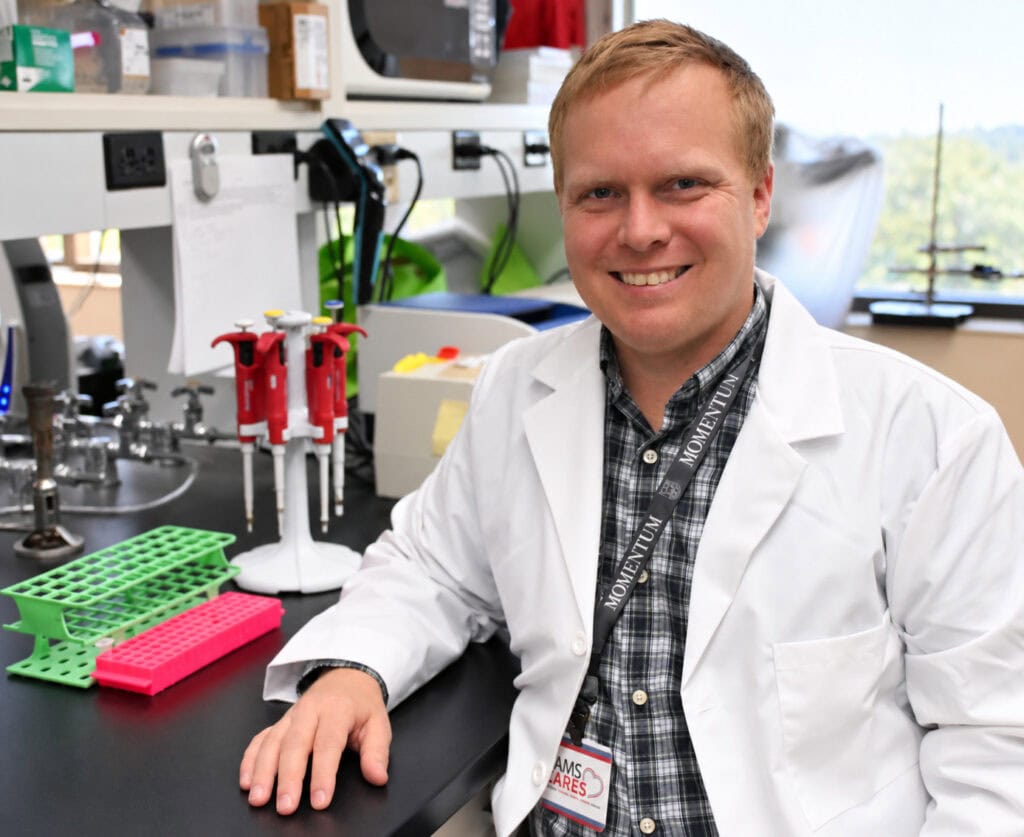
With a new five-year $2.2 million grant from the National Institute of Allergy and Infectious Diseases, he’s studying Acinetobacter baumannii, a pathogen associated with roughly 30% of VAP cases. It is also one of the hardest to treat, with the highest rate of drug resistance of any Gram-negative bacterium.
When VAP is caused by drug-resistant bacteria like A. baumannii, the death rate can reach 30 to 50%. The World Health Organization and the Centers for Disease Control and Prevention have both identified A. baumannii as a major public health concern.
Why the Tube Matters
Intubation irritates the windpipe and coats the breathing tube with proteins that bacteria can cling to, letting them form a slimy film called a biofilm. The tube also keeps the airway from clearing itself, so mucus pools and shelters bacteria from both the immune system and antibiotics.
A Better Way to Study It
Dr. Jackson-Litteken says the lab models that scientists have relied on for decades don’t look much like a real ventilated patient. His project will:
- Use breathing tubes recovered from patients to build the first lab model that realistically mimics how bacteria stick to and grow on them.
- Use a new mouse model, which he adapted for this bacterium, to identify how it causes pneumonia.
- Combine the two approaches to test tube treatments designed to prevent infection.
Because these tools reflect the general conditions of a ventilated airway, they could also be used to study other bacteria that cause VAP.
“I hope to characterize the regulatory pathways that enable bacteria to adapt to the endotracheal tube microenvironment and promote infection,” he says.
Laura James, M.D., Director of the Translational Research Institute and Associate Vice Chancellor for Clinical and Translational Research, and Shannon Dare, M.D., Associate Professor in the Department of Anesthesiology, are helping him obtain clinical samples so his models reflect what happens in real patients.
“Studies like this will help ICUs better manage patients on ventilators and prevent respiratory infections,” he said.
Dr. Jackson-Litteken earned a Ph.D. in Microbiology and Immunology at UAMS under the mentorship of Jon Blevins, Ph.D., Professor and Chair of the department, followed by postdoctoral research at Washington University in St. Louis.