
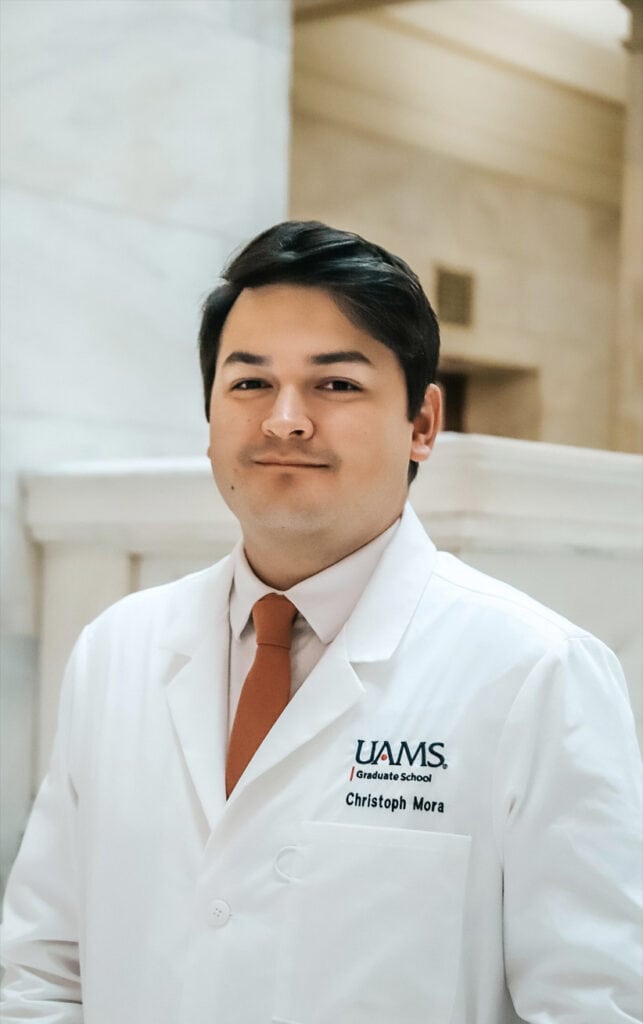
For Christoph Mora, the email announcing his NIH fellowship arrived in the middle of a workday, so the celebration had to wait. “I couldn’t pop a bottle of champagne right then, but I did after work,” he said.
The Ph.D. candidate in the UAMS Graduate School received a two-year, $81,508 F31 fellowship from the National Institutes of Health (NIH) National Heart, Lung, and Blood Institute. The award supports his training and research into how immune cells contribute to hypertensive heart failure, work he does in the laboratory of Shengyu Mu, M.D., Ph.D., Chair of the Department of Pharmacology and Toxicology.
The fellowship was a long time coming. Mora first submitted the application in 2024, but his NIH study section was repeatedly postponed and then canceled. He resubmitted it in 2025, learned in February that he had earned a good impact score, and finally received notice of the award in July 2026.
“It was a test of endurance for sure,” he said. “A lot of the research we do requires persistence in the face of setbacks. You just have to keep pushing.”
The Science Behind the Fellowship
The work was worth the wait. Hypertension affects nearly 30% of adults worldwide and almost half of U.S. adults. It has no outward symptoms, so cardiac damage can accumulate silently for years or even decades.
Mora’s research looks at the earliest stages of that process rather than the end stage. His first aim examines how T cells accumulate in the hypertensive heart and affect heart muscle cells. His second explores macrophage-to-myofibroblast transition, a newly described process that may drive harmful scarring in the heart.
What has surprised him most is how deeply immune dysfunction is tied to chronic disease.
“The extent to how many chronic diseases today are caused or accelerated by dysfunctional immune cells cannot be overstated,” he said.
He was just as impressed by the tools used in Dr. Mu’s lab, from the microsurgeries used to model high blood pressure to flow cytometry.
Flow cytometry, which he had never been introduced to before, can identify many cells and cell subtypes in a single sample.
“It’s one of the best ways to study different populations of cells, and the specificity you can get is stunning. It’s incredible how efficient and powerful some of these technologies can be.”
Those techniques are part of a research program that has been building for years. Dr. Mu’s NIH-funded work began with a $1.89 million grant in 2019 to explore the link between immune cells and high blood pressure. Since then, his lab has made substantial discoveries that show abnormal immune responses contribute to high blood pressure and associated organ damage. These discoveries have paved the way for the next phase of the lab’s research, which received an additional $3.7 million from the NIH in 2024.
Mora’s award continues a strong record of F31 success in Dr. Mu’s lab, following Katie Deck’s award in 2024. That success reflects the laboratory and department’s commitment to graduate training, individualized mentorship, and preparing trainees to compete for national research funding.
Chasing the Missing Pieces
Mora’s path to scientific research started early. He grew up in Austin, Texas, the middle child of six. His father, an engineer, and his mother, an accountant, both prioritized education and pushed their children to excel.
“It wasn’t without challenges, but I do think I had an affinity for STEM subjects,” he said.
He credits his father for his early grounding in mathematics. “It’s nice when you get a math problem to click.”
A high school biology course sealed his interest in the sciences.
“That class leaned heavily into biochemistry, and that solidified that I would go into some sort of natural science field,” he said. “A lot of it was logical, and that appealed to me”
While in college at Ave Maria University in Florida, Mora had the opportunity to do two research internships, including one at the University of Florida Institute of Food and Agricultural Sciences.
“I did seriously consider agricultural science, but, ultimately, I loved putting together the missing pieces inside our own biology.”
Finding a Home at UAMS
After graduating from Ave Maria with a degree in biochemistry, Mora chose UAMS for graduate school.
“What stuck out the most about UAMS was the amount of NIH funding and the number of labs doing different types of research, especially for the size of the school,” he said.
Mora’s wife, Laura, a Little Rock native, was also accepted into the program. The graduate school’s competitive stipend helped simplify the decision.
Mora rotated through four UAMS labs and liked them all, which made the choice difficult. At the start of graduate school, he got some good advice: the lab you join should be in a research field that interests you, have funding for a graduate student, and be an environment where you’re comfortable.
Dr. Mu’s lab fit all three. “I was definitely interested in cardiovascular disease, the lab techniques, and the questions his lab was trying to answer,” he said. “The pharmacology department as a whole was also so warm and welcoming.”
Mora also points to Dr. Mu’s supportive mentorship style and to senior grad students and researchers who were glad to answer his questions.
The lab’s unofficial mantra is “there are no stupid questions.”
“Dr. Mu encourages you to be curious,” Mora said. “He pushes you to look at things from many different angles.”
Mora’s research focuses on the heart, but he draws on what lab colleagues are learning about the kidney, and on articles and new techniques from the wider field that might apply to his research.
What’s Next
Mora is writing his dissertation, a document that will likely range from 100 to 250 pages. After he finishes and successfully defends it, he plans to pursue a postdoctoral position to gain independence and start designing his own research projects.
“I definitely want to stay in academia,” he said. “I’d like to do a postdoc to gain a little more independence and begin to design my own research projects. I’d also like a taste of administrative work to see if I might want to be a PI.”
His interests lean translational. “I do love basic research, but I’m drawn more to the translational and clinical side of things, learning what’s happening inside the human body in a chronic disease condition.”