• Skip to primary navigation
  • Skip to main content
  • Skip to primary navigation
  • Skip to main content
Choose which site to search.
University of Arkansas for Medical Sciences Logo University of Arkansas for Medical Sciences
College of Medicine: Department of Family and Preventive Medicine
  • UAMS Health
  • Jobs
  • Giving
  • About Us
    • The DFPM Chair
    • Department News
    • DFPM Research Symposium
    • DFPM CARE Awards
    • Verification of Residency Training
    • Available Positions
  • Residency Programs
    • Family Medicine Residency Programs
    • Preventive Medicine Residency Program
  • Community Health and Education
    • Upcoming Events
    • CME/CE for Family Medicine
    • Partnerships in Colorectal Cancer Screening for Arkansas
      • Who We Are
      • Providers’ Resources for Colorectal Cancer Screening
      • Patient Resources
      • PiCS-AR! Raises the Bar
  • Research and Scholarly Activity
    • Clinical Research
    • Community Research
      • Research & Evaluation
        • Arkansas Early Childhood Care & Education Financing: Cost Modeling & Market Price Analysis
        • Arkansas Workforce Studies
        • Child & Youth Mental Health
        • Healthy Families America (HFA)
        • Home-Visiting Support for Low-Birth-Weight Preterm Infants
        • Parents as Teachers (PAT) Arkansas
      • Research-Based Early Childhood Professional Development
        • Engage Continuum
        • FIRST:ECE
        • TIPS
        • WOW
        • Family Map
        • Project PLAY
        • REACH
        • WISE
        • Strengthening Families
      • Research and Evaluation Division Faculty
        • Nikki Edge, Ph.D.
        • Lorraine McKelvey, Ph.D.
        • Taren M. Swindle, Ph.D.
        • Kanna Lewis, Ph.D.
      • Contact RED
    • Publications
  • Medical Student Education
    • Junior Clerkship
      • Clerkship FAQs
      • Clerkship Syllabus
      • Contacts
      • Community and Housing
    • Senior Students
      • Residency Resources and Timeline
      • Post Match Survey
      • Student Alumni Sign-up Form
    • Scholarships and Loan Repayment
      • Harold H. Hedges III, M.D., Endowed Scholarship in Family Medicine
    • Student Conferences
  • DFPM Offices
    • Communication and Departmental Relations
    • Digital Health
    • Leadership and Professional Development
      • DFPM Chair’s Awards for Recognition of Excellence (CARE)
        • Chair’s Awards for Recognition of Excellence Nomination Form
    • Wellness
      • DFPM/PCPHSL MVP Award Nomination Form
        • MVP of the Month Recipients
  1. University of Arkansas for Medical Sciences
  2. College of Medicine
  3. Department of Family and Preventive Medicine
  4. Department News
  5. Page 13

Department News

Robust Family Medicine Research, Strong Residency Highlighted at Poster Day

By Amy Widner

Great things are happening in the UAMS College of Medicine’s Department of Family and Preventive Medicine, with a recent research poster day as just the latest sign of the department’s “good health.”

The poster session featured 35 posters, including 20 projects by residents. Topics included residency administration and education, ethics, case reports, improvements in patient care, and research on medical conditions like anemia, HIV, COPD and chlamydia.

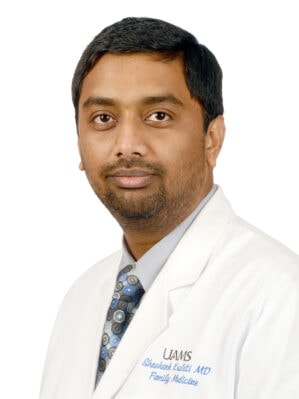
Event organizers were Shashank Kraleti, M.D., residency program director, and Diane Jarrett, Ed.D., assistant residency director and director of education and communications for the department. They said the poster session gave residents a chance to highlight the department’s strong commitment to research and to practice their presentation skills in a laidback environment at their home campus before showcasing their work elsewhere.

Doctors talking near poster

Family medicine resident Appala Suman Peela, M.D., facing camera, talks with faculty member Stephen Sorsby, M.D.

“Family medicine isn’t a field that’s necessarily thought of as a huge research-producing specialty, when in fact, our department has a lot going on,” Jarrett said. “So events like these serve a dual purpose. They show our residents that the academic projects they participate in are important and that others are interested in their results, and it showcases to the wider campus all the great things that are going on in our department.”

Kraleti said he thinks the emphasis on research results in better physicians and patient care.

“I have always believed that when residents do research, they take an extensive look at a particular topic and gain knowledge that they can use in their practice,” Kraleti said. “Research also gets residents thinking creatively and proactively about how they can contribute to improving patient care in their clinic and beyond.”

Doctors talking near poster

Obioma Nwaiwu, M.D., Ph.D., left, talks about his project with fellow resident Paige Beck, M.D., Ph.D., while his research partner, Brian Yuen, M.D., looks on.

For example, third-year residents Obioma Nwaiwu, M.D., Ph.D., and Brian Yuen, M.D., presented their poster on how to improve shared decision making between providers and patients for prostate cancer screening, especially given that new guidelines leave the decision on whether to screen up to the patients.

Nwaiwu and Yuen tried passive approaches like handing patients flyers in the waiting room. They also tried more direct approaches like calling the patient on the phone before their appointment and contacting providers to remind them of the new guidelines.

They found that the direct approaches significantly improved the shared decision-making process.

Doctors at poster

Research and Evaluation Division faculty member Lorraine McKelvey, Ph.D., left, listens to Program Coordinator Kisa Vaughn, MPA, near Vaughn’s poster on the Passion Project.

“What this tells us is that when you empower the patient, when you empower the provider and tell them about the changes in the guidelines and give them some of the statistics involved, then they can really talk about it and come up with the decision that is best for the patient,” Nwaiwu said.

These opportunities for resident research haven’t developed in a vacuum. The department’s Research and Evaluation Division (RED) started 10 years ago. The residency program has also developed a strong research and scholarly activity curriculum for the residents and the faculty. And across the department, Kraleti said the faculty do an amazing job on both their own work and investing time to collaborate with the residents.

“They are very strong and produce a lot of work, and the clinical side and research side are always looking for collaborations,” Kraleti said. “It’s paid off. We do posters and presentations nationally and internationally, and there are lots of publications. By the time we started thinking about a poster session on campus, it was well overdue.”

Crrowd shotThe first event was in the fall and featured 25 posters. Now in the spring, the event is intended as an annual tradition, and Kraleti said they may expand it to a research day with presentations in the future.

The Family Medicine program was also recognized at Dean’s Honor Day in the spring. Kraleti won the Residency Educator Award. Nicola Edge, Ph.D., won the Faculty Excellence in Research Award. Shalese “Fitz” Fitzgerald, M.S., won the Staff Excellence in Research Award.

“It was wonderful to see our research efforts in family medicine recognized,” Kraleti said. “Several of our faculty were promoted this year. We also have had a 100% board pass rate for our residency program for seven years, which puts us among the best in the country. We feel we have good synergy happening within the department, and we’re happy to feature it with events like this.”

Filed Under: Residency

DFPM-RED Faculty Receives New Grant

Taren Swindle
Dr. Taren Swindle

Taren Swindle, Ph.D., Department of Family and Preventive Medicine, De-Implementation of Detrimental Feeding Practices in Childcare, NIH/Nat. Inst. of Diabetes & Digestive & Kidney Diseases (01/03/2019 – 12/31/2020), $228,473.

Filed Under: Research and Evaluation Division

DFPM-RED Faculty member takes honor at 2018 council, section meetings

DFPM-RED’s Dr. Lorraine McKelvey received a research award during recent AAP council and section education meetings.

AAP Council on Child Abuse and Neglect

Best Abstract Award

Lorraine McKelvey, Ph.D.

“Interrelatedness of Adverse Childhood Experiences: Exploring Patterns of Exposure and Impacts on Development in Infancy and Toddlerhood”

LINK

Filed Under: Research and Evaluation Division

Family and Preventive Medicine Receives 5-Year $3.29 Million Grant from CDC to Reduce Obesity

By Amy Widner

The Department of Family and Preventive Medicine at the University of Arkansas for Medical Sciences (UAMS) has received $3.29 million from the Centers for Disease Control and Prevention (CDC) for a five-year project to reduce obesity, increase physical activity and improve nutrition in Arkansas, especially in the Delta.

The State Physical Activity and Nutrition (SPAN) project funding began Oct. 1 and was awarded to the Department of Family and Preventive Medicine’s Community Health and Education Division. Alysia Dubriske, director of Community Health and Education at UAMS, is leading the grant.

“The whole premise of this grant is to try to reduce obesity rates. The CDC has identified target areas, including access to better nutrition, increasing breastfeeding, encouraging healthier foods and physical activity in early childcare centers, and improving activity-friendly communities,” Dubriske said. “At UAMS’ Department of Family and Preventive Medicine, we already have many projects in these areas, so we are looking forward to combining the progress we’ve already made with the CDC’s support to show measurable improvement on this important health issue.”

UAMS staff will be working in partnership with local leadership and stakeholders across the state, but especially in counties where life expectancy is lower than national and state averages. Many rural counties in the eastern Arkansas Delta fall into this category. Obesity, diabetes, high blood pressure, low physical activity, poverty and lack of access to health care are factors.

The project aims to:

  • Develop and implement food service guidelines for food pantries, early childhood education centers, developmental disability day centers and local parks.
  • Support breastfeeding by partnering with family practice clinics, early childhood education centers and developmental disability day centers and by offering continuing medical education hours and early childhood center and developmental disability center professional development training.
  • Partner with communities to create activity-friendly routes to connect everyday destinations by implementing local policies to include bike routes, sidewalks and trails that increase safety and access for all abilities.
  • Implement nutrition standards and physical activity standards into early childhood education centers across the state by changing the Quality and Improvement Rating System in Arkansas to increase physical activity, increase nutrition and physical activity education to staff, and decrease screen time.

Assisting Dubriske with the project are Christopher Long, Ph.D., senior director of Research and Evaluation at the UAMS Northwest Regional Campus; and Leanne Whiteside-Mansell, Ed.D., director of the Research and Evaluation Division in the UAMS Department of Family and Preventive Medicine, which is part of the UAMS College of Medicine. Bettie Cook, senior research administrator at UAMS, assisted with the successful grant application.

Filed Under: Community Health and Education, Research and Evaluation Division

William Ventres, M.D., Invested in Ben Saltzman, M.D. Distinguished Chair in Rural Family Medicine

Sept. 19, 2018 | William “Bill” Ventres, M.D., M.A., assistant professor in the Department of Family and Preventive Medicine in the College of Medicine at the University of Arkansas for Medical Sciences (UAMS), was invested Sept. 17 as the holder of the Ben Saltzman, M.D., Distinguished Chair in Rural Family Medicine.

Ventres, who joined UAMS in 2017, is a family physician and medical anthropologist with more than 30 years of clinical experience working with disadvantaged patients. He is known as a leader in developing family medicine internationally, researching doctor-patient communication using qualitative methods, and studying the social history of family medicine in the United States. He plans to encourage students and residents to practice in rural and underserved areas in Arkansas to improve health outcomes.

Westfall and Knight presented Ventres with a commemorative medallion.

Westfall and Knight presented Ventres with a commemorative medallion.

“It is a great honor to receive the Saltzman Chair, with its emphasis on rural and underserved family medicine,” Ventres said. “When I was in medical school and residency, I saw that lots of patients felt left out. Sometimes they were poor or uneducated, sometimes it was because of where they lived, and sometimes it was because of the color of their skin or the language they spoke. I didn’t see that medicine was doing a very good job helping these people, so I found my small niche in working to try and change things in this area.”

An endowed chair is among the highest academic honors a university can bestow on a faculty member. A distinguished chair is a $1.5 million endowment established to support the educational, research and clinical activities of the chair holder who will lead future innovations in medicine and health care. Those named to a chair are among the most highly regarded scientists, physicians and professors in their fields.

“The choice of Dr. Ventres to assume this chair is a very wise decision, and that’s because of his passion for the very highest quality of medicine and for his passion for taking care of his fellow man, which he has demonstrated throughout a long career and all parts of the world,” said Christopher T. Westfall, M.D., dean of the College of Medicine. “I am absolutely convinced that he is the right holder for this chair.”

The chair is named in honor of Ben Saltzman, M.D., who has been called the father of rural family medicine in Arkansas. Saltzman joined UAMS in 1974 as the first professor and chair of the Department of Family and Community Medicine. During his seven-year tenure, he served as director of rural medicine development and the flexible internship program. In 1981, he was appointed director of the Arkansas Department of Health and served until his retirement in 1987. Saltzman died in 2003.

Saltzman built the first hospital in Mountain Home and helped establish others across the state. He is remembered as a champion of rural health and an international leader in helping eradicate polio. Saltzman made health care more widely available and worked as a traveling doctor who owned a twin-engine plane for his work.

Saltzman was past president of numerous statewide health organizations, including the Arkansas Lung Association, what is now The Arc Arkansas, the Arkansas division of the American Cancer Society and the Arkansas Board of Health. He served as chairman of the American Medical Association’s Council on Rural Health, as a member of the U.S. Department of Health and Human Services’ Community Health Project Review Committee, and as a member of the National Advisory Health Services Council.

“Dr. Saltzman was quite a leader in our state, and this endowment is to help those who follow his example as we expand our programs for the underserved and in rural medicine,” said Daniel Knight, M.D., professor and chair of the Department of Family and Preventive Medicine. “In his short tenure here, Dr. Ventres has made quite a difference, and we’re excited to see the difference he’ll make going forward.”

Ventres with his wife, Estella and daughter, Cory.

Ventres with his wife, Estella and daughter, Cory.

Ventres was presented with a commemorative medallion by Westfall and Knight. He thanked Saltzman and recognized Julea Garner, M.D., the previous chair holder. Ventres reserved special thanks for his wife, Estella and his children, Roby and Cory, who were in attendance.

“With all the technologies that are supposed to make things smoother, we are sometimes prone to overlook what is most important in our work – the people we serve,” Ventres said. “I commit to you to learning from the people of Arkansas, as I am able, to see them as full of worth and dignity; to appreciate their presence; and to engage with them in a way that invites conversation, collaboration and compassion.”

“The work of improving the health of all Arkansans, wherever they may be, is not the task of one person – it is a responsibility we all share,” Ventres said. “And we are all enriched by the labor we invest to fulfill it.”

Ventres received his medical degree from the University of Minnesota Medical School and completed his residency and fellowship training in family medicine at the University of Arizona College of Medicine in Tucson. He has received two Core Fulbright U.S. Scholar awards and has taught family medicine residents at the National Experimental University of Táchira in San Cristobal, Venezuela, and public health students at the University of El Salvador in San Salvador. Prior to his arrival at UAMS, he was a research associate for five years in the Institute for Studies in History, Anthropology and Archeology at the University of El Salvador.

Ventres has served as visiting professor at Nelson Mandela University in Port Elizabeth, South Africa, and scholar-in-residence at both the Brocher Institute in Geneva, Switzerland and the Institute for the Medical Humanities at the University of Texas Medical Branch at Galveston.

Filed Under: News

New Grants, Contracts, and Publications

DFPM-RED is active and busy making a difference in the lives of Arkansans through our research-based work throughout the state! Here are a few of the recent highlights.

Publications

McKelvey, L. M., Fitzgerald, S. K., Conners-Edge, N. A., & Whiteside-Mansell, L. (2017, in press). Keeping Our Eyes on the Prize: Focusing on the Parent-Child Relationship Supports Depressed Parents’ Involvement in Home Visiting Services. Maternal and Child Health Journal.

Swindle, T., Selig, J., Rutledge, J.M., Whiteside-Mansell, L., & Curran, G. (In Press). Fidelity Monitoring in Complex Interventions: A Case Study of the WISE Intervention. Archives of Public Health

Grants/Contracts

Gilead HIV project – We’ve hired a community health worker and trainer/data person for the Gilead HIV project in collaboration with the Pulaski County Drug Court

DFPM-RED faculty member Nikki Edge, Ph.D., is collaborating with Russellville school district and NLR preschools to implement a pilot ‘trauma-informed’ classrooms.

DFPM-RED’s Cindy Crone and LaTunja Sockwell will be part of a homeless project with Our House funded by SAMHSA.

“UAMS and Our House are excited to share that the Home Together grant application to SAMHSA that your organization supported has been funded for five years. This provides an innovative and much-needed opportunity to improve health and social outcomes of homeless or housing insecure pregnant women and mothers of young children to age five who also have serious mental illness (SMI) or co-occurring mental illness and substance use disorder (COD).” 

New HIV Grant from Arkansas Department of Health Prevention & Viral Hepatitis C Program, HIV Education ($40,000)

Filed Under: Research and Evaluation Division

Three Tests for Carpal Tunnel Syndrome

John Bracey, M.D., hand surgeon with the UAMS Department of Orthopaedic Surgery, said that carpal tunnel syndrome affects 2.7 percent of the population and nets 500,000 surgeries a year in the United States, estimated to be a $2 billion annual impact.

Bracey spoke to family medicine providers at the 40th Annual Family Medicine Intensive Review Course last May, covering how providers can test for carpal tunnel and how to manage it.

A few tests he recommended were:

Tinel’s sign (lightly tapping over the nerve to see if it generates a tingling sensation)

Phalen’s test (pushing the dorsal surface of hands together and holding 30 – 60 seconds)

Carpal Compression Test (Apply pressure with thumbs over the median nerve within the carpal tunnel, located just distal to the wrist crease. The test is positive if the patient responds with numbness and tingling within 30 seconds.)

If the patient shows signs of carpal tunnel syndrome, the provider can conservatively manage with a neutral wrist brace (helpful during sleep), stretching and exercises, ergonomic interventions or steroid injection.

Filed Under: Community Health and Education

Windy WISE featured on KATV Saturday Daybreak!

DFPM-RED‘s WISE (We Inspire Smart Eating) was featured on KATV’s Saturday Daybreak on Saturday, June 23rd. DFPM-RED faculty member Dr. Taren Swindle appeared with Windy WISE and demonstrated a food experience from the WISE curriculum currently in use in locations all across Arkansas.  Watch the segment by clicking on the link below.

Watch Windy WISE on Daybreak!

Filed Under: Research and Evaluation Division

WISE Childhood Nutrition Program Wins Education Award

Rarely are child temper tantrums a sign of success, but this is one of those circumstances.

The Together, We Inspire Smart Eating – has been working to introduce fresh fruits and vegetables into the diets of Arkansas children since 2011.

“Parents come into the program thinking, ‘oh, my child won’t eat that,’ but then we hear stories about kids throwing fits in the grocery store aisles, not because they want candy, but because they want green beans. Those are their own kind of success story,” said Leanne Whiteside-Mansell, Ed.D., principal investigator for WISE and a professor in the Department of Family & Preventive Medicine in the College of Medicine.

The WISE program recently welcomed another – more formal – acknowledgment of its success: The Journal of Nutrition Education and Behavior recognized a report about WISE with its 2018 Best GEM (Great Educational Materials) award.

The journal’s committee selected finalists for the recognition, which was voted on by its board of editors. The award recognizes innovativeness/creativity, quality of design, quality of writing and presentation and quality of evaluation. The report was titled “Together We Inspire Smart Eating: A Preschool Curriculum for Obesity Prevention in Low-Income Families,” by Whiteside-Mansell and Taren M. Swindle, Ph.D., an assistant professor in the Department of Family & Preventive Medicine.

WISE is for children age 3-8 to establish healthy early eating habits and encounter a variety of fruits and vegetables – with the ultimate aim of combating childhood and adult obesity. It includes a classroom curriculum, educator training and parent education outreach materials. There are versions of the program for pre-K and kindergarten through first grade.

Food preparation tools like measuring spoons and blenders used in the classroom as part of the WISE program are branded with Windy the owl’s image.

WISE is organized around eight monthly units. Windy Wise, a barn owl puppet, brings letters from farms to the classroom to introduce the featured fruits and vegetables to children: apples, tomatoes, broccoli, sweet peppers, carrots, berries, greens and green beans. Activities throughout the month allow the children to explore the food and use it in recipes.

The program also includes educator training and parent engagement through backpack letters from the farmer and a Facebook and Pinterest page. Windy Wise’s branded logo is printed on utensils used by educators in the classroom and is featured on cardboard cutouts in participating grocery stores.

The program is specifically designed to be effective with high-risk children from resource-poor backgrounds. It is being used in 147 classrooms in Arkansas and 30 classrooms in Louisiana.

Whiteside-Mansell and Swindle have made some interesting discoveries during their time on the project. During their preliminary research before designing the curriculum, they found that 25 percent of Head Start children hadn’t had an apple at home. Among the educators, many lacked food as children, and 33 percent reported still experiencing bouts of food insecurity.

With this context in mind, the WISE program encourages families and educators alike to cultivate healthy food habits such as allowing kids to decide how much to eat, so they only eat when they are hungry and are not urged to “clean their plates” or “make happy plates.” Kids are also encouraged to play with their food and see it transform, which makes them more likely to try unfamiliar foods.

Children can also find Windy by the fruits and vegetables in participating grocery stores.

“When we go for classroom visits, that cue to ‘make a happy plate’ still frequently comes up. At first we didn’t understand why, because we cover the negative results of that in the training, but once we surveyed our educators and found their history – and for some, current struggles – with food insecurity, it made more sense. In certain cultures, and the South is one of them, that is a hard habit to break,” Swindle said.

The curriculum is also organized to be budget-sensitive and value the educator’s time. For example, many of the food activities include math or reading or other activities that educators are required to include in their classroom time.

“We’ve tried to make it something that helps educators meet their goals, not something that needs to be tacked on as an additional requirement or afterthought. It can’t compete with other requirements,” Whiteside-Mansell said.

The program also emphasizes the connection between food, people and the land, instead of the abstract notion of food coming from stores or restaurants. The letters from farmers that introduce the foods and communicate with parents feature a variety of types of farming families – from small, backyard-gardens to large-scale family farms and everything in between.

“We’ve documented positive changes in the behavior of children, teachers and parents. We feel that Windy Wise is helping change the culture in the places she visits, and we’re happy to have some of that recognized with the award,” Whiteside-Mansell said.

WISE is a project of the Department of Family and Preventive Medicine Research and Evaluation Division (RED), which Whiteside-Mansell directs.

Funding for WISE comes from grants from the U.S. Department of Agriculture National Institute of Food and Agriculture, UAMS Translational Research Institute, National Institutes of Health National Center for Research Resources and the National Center for Advancing Translational Sciences.

Filed Under: Research and Evaluation Division

DFPM-RED’s Project PLAY is in the news!

The Arkansas Democrat-Gazette has highlighted the great work being led by a collaboration between UAMS, The Division of Child Care and Early Childhood Education, and Arkansas State University.  Dr. Nikki Edge was lead with Project Play but special recognition should also be given to RED’s Angie Kyzer and Zach Patterson for the development and implementation of the online BehaviorHelp system.  Dr. Edge developed Project Play, Ms. Kyzer has many talents but in this was key in conceptualizing the online system, and Mr. Patterson wrote the online computer code to make this effort a reality.

Read the full article.


Filed Under: Research and Evaluation Division

  • «Previous Page
  • Page 1
  • Interim pages omitted …
  • Page 11
  • Page 12
  • Page 13
  • Page 14
  • Page 15
  • Next Page»
UAMS College of Medicine LogoUAMS College of MedicineUniversity of Arkansas for Medical Sciences
Mailing Address: 4301 West Markham Street, Little Rock, AR 72205
Phone: (501) 686-7000
  • Facebook
  • X
  • Instagram
  • YouTube
  • LinkedIn
  • Pinterest
  • Disclaimer
  • Terms of Use
  • Privacy Statement
  • Legal Notices

© 2026 University of Arkansas for Medical Sciences