• Skip to main content
  • Skip to main content
Choose which site to search.
University of Arkansas for Medical Sciences Logo University of Arkansas for Medical Sciences
College of Medicine: Department of Surgery
  • UAMS Health
  • Jobs
  • Giving
  • About Us
    • Department News
    • Philanthropy
  • Faculty
  • Divisions
    • Breast Oncology
      • Our Mission
      • Pioneering Health Care
    • Burn Surgery
    • Colorectal Surgery
    • Endocrine Surgery
    • General Surgery
    • Hepatobiliary Surgery
    • Pediatric Cardiovascular Surgery
    • Pediatric General Surgery
    • Plastic and Reconstructive Surgery
    • Surgical Oncology
    • Thoracic Surgery
    • Transplantation
    • Trauma and Acute Care Surgery
      • Acute Care Surgery Guidelines
    • Vascular Surgery
      • Aortic Emergencies
      • Vascular Laboratory
    • Education Division
  • Education
    • Office of Surgical Education
    • Medical Student Education
      • Junior Clerkship
        • Goals and Objectives
        • Conferences
        • Learning Resources
        • Junior Clerkship Assessment
      • Senior Surgery Electives
      • Senior Surgery Honors Course
        • Objectives
        • Readings
      • Summer in Surgery
      • Plastic and Reconstructive Surgery Interest Group
  • Residency Programs
    • General Surgery
      • Our Residents
      • Curriculum
        • ABSITE/Board Prep
        • Simulation
        • Conferences
        • Program Objectives
        • Assessment
      • Schedules
        • Development
        • Rotation Objectives
        • Rotation Schedules
        • Clinical Sites
      • Resident Life
      • Guidelines for Selection
      • Benefits
      • Recent Graduates
    • Vascular Surgery
      • Program Information
        • Competencies
          • PGY-1 Competencies
          • PGY-2 Competencies
          • PGY-3 Competencies
          • PGY-4 and PGY-5 Competencies
        • Curriculum
        • Rotation Schedule
      • Training
        • Clinical Training Sites
      • Apply
      • Current Residents
      • Living in Little Rock
  • Fellowship Programs
    • Breast Surgery
    • Pediatric Surgery
    • Surgical Critical Care
      • How to Apply
      • Faculty
      • Fellows
      • Fellow Schedule
      • Living in Little Rock
      • Contact Us
    • Vascular Surgery (5+2)
      • Application Process
      • Our Fellows
      • Information for Applicants
  • Surgical Research
    • Basic Science Surgical Research Fellowship Program
      • Getting Started
      • Funding Opportunities
      • Research Advisory Committee
      • Approvals and Training
      • Research Fellows
    • Annual Conferences
    • Ongoing Research
      • Ongoing Research — Basic Science
      • Ongoing Research — Clinical
    • Laboratories
      • Burdine Laboratory
        • Research
        • Lab Members
        • Meet the PI
    • Office of Health Initiatives and Disparities Research
      • Meet Our Team
      • Community Engagement
      • Health Policy
      • Patient Navigation Programs
      • Training/Mentoring
    • Research Seminars
      • Fifth Annual Surgery Research Symposium
    • Research Resources
    • Funding Opportunities
    • News and Events
    • Recent Publications
  • Chest Club
  1. University of Arkansas for Medical Sciences
  2. College of Medicine
  3. Department of Surgery
  4. Department News
  5. Morrilton Mom Donates Kidney to Toddler Son

Morrilton Mom Donates Kidney to Toddler Son

By Katrina Dupins

Nov. 28, 2018 | The pain following surgery ended up being greater than she anticipated, but Jessica Stacy says she would change it for nothing. The Morrilton mother smiles as she watches her 2-year-old son play happily with his toys, 10 days after she’d given him one of her kidneys.

Stacy was 16 weeks pregnant when her doctor discovered Wesley had posterior urethral valves. Posterior urethral valves occurs in about 1 in 8,000 baby boys. It happens when there are extra flaps of tissue growing in the urethra, preventing it from properly carrying urine from the bladder and out of the body. When urine cannot be expelled, organs in the urinary tract become swollen and damaged.

Jessica Stacy

We knew that either of us would do whatever it took to help him,” Jessica Stacy said.

“We were both devastated, of course,” Stacy said. “And though we didn’t know what all was required, we knew that either of us would do whatever it took to help him. If it meant that one of us would have to give him a kidney, we would do it.”

Wesley spent 100 days at Arkansas Children’s Hospital after his birth in Conway and had been hospitalized multiple times in his short life. Doctors said he’d have to wait until he was 2 before he could receive a transplant.

“Alan and I were both ready,” Stacy said. “Since he had some obstacles he had to overcome before they would test him, we moved forward with my testing. And here we are.”

Wesley Stacy playing with a toy tractor

Wesley Stacy received a kidney from his mother Oct. 17.

Stacy and Wesley went in for surgery Oct. 17. Stacy’s transplant surgeon was Gerardo Tamayo-Enriquez, M.D., an assistant professor in the UAMS College of Medicine Department of Surgery, Division of Transplant Surgery. Tamayo hopes more people will consider becoming a living donor. Researchers have studied the long-term health of living donors and have found that many of them actually have a longer life expectancy than the general population.

Gerardo Tamayo-Enriquez, M.D.

Gerardo Tamayo-Enriquez, M.D.

“It’s not because they donated a kidney,” Tamayo said. “But because they were healthy enough to donate and are kept under medical supervision for the rest of their lives.”

Kidneys from living donors are also better for the recipient because they are outside the body for less time than a kidney from a deceased donor.
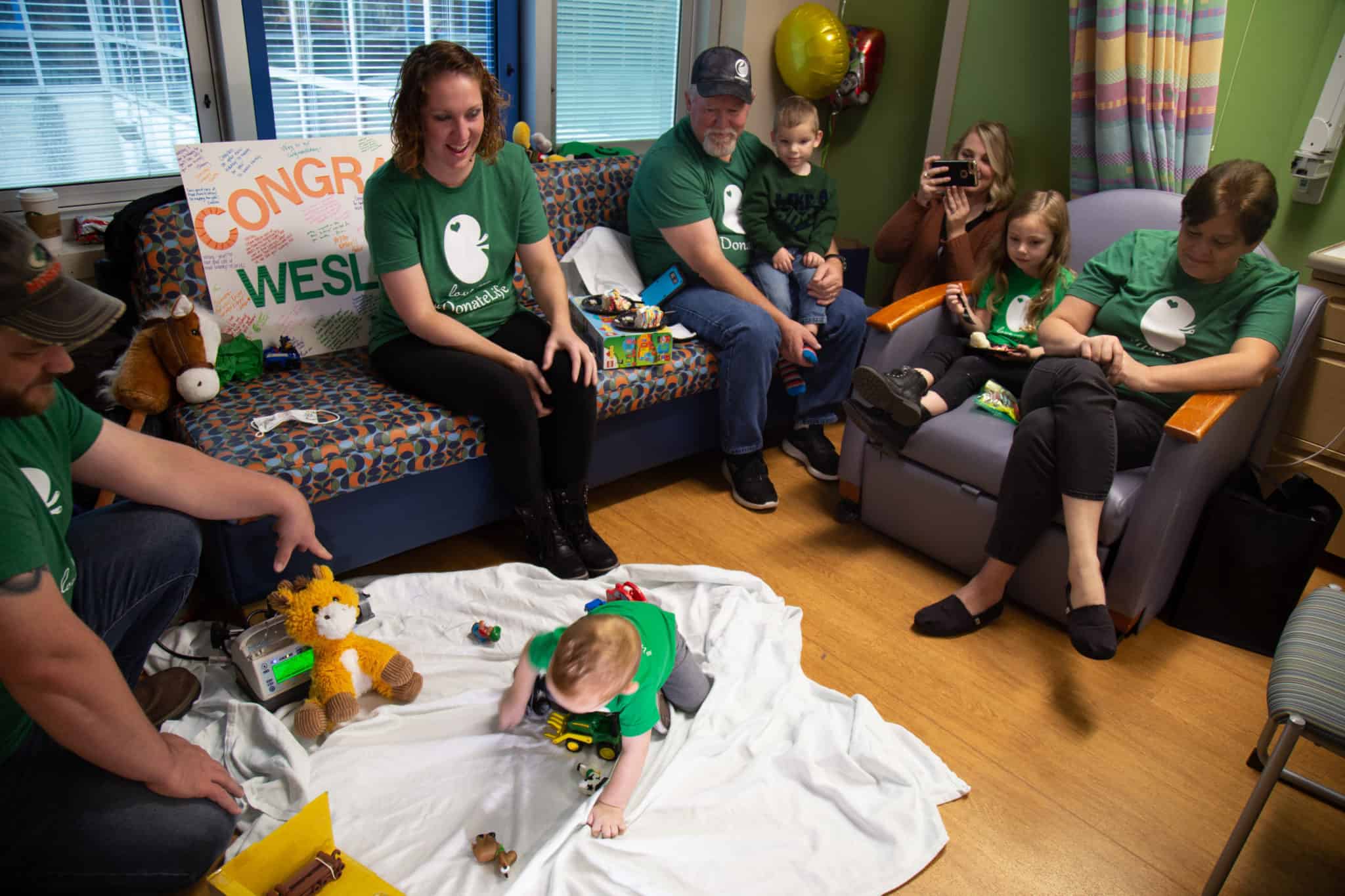
Kidney party with child on a blanket and adults around him

On the day he was discharged, Arkansas Children’s threw a kidney party for Wesley.

Tamayo says the chances of developing high blood pressure or diabetes (the two most common causes of kidney failure in the U.S) are the same with one or two kidneys. If the condition becomes severe enough, a patient with one kidney will develop renal failure more quickly. The other potential disadvantage is in the case of trauma.

On the day he was discharged from the hospital, the transplant coordinator, physicians, nurses and counselors gathered with Stacy, Alan, Wesley and his sister, Reese, for a kidney party, complete with balloons, cake and toys.

“I just did what any parent would do,” Stacy says. “I’m just so happy because I know he is no longer in pain.”

Posted by Chris Lesher on November 28, 2018

Filed Under: Department News

UAMS College of Medicine LogoUAMS College of MedicineUniversity of Arkansas for Medical Sciences
Mailing Address: 4301 West Markham Street, Little Rock, AR 72205
Phone: (501) 686-7000
  • Facebook
  • X
  • Instagram
  • YouTube
  • LinkedIn
  • Pinterest
  • Disclaimer
  • Terms of Use
  • Privacy Statement
  • Legal Notices

© 2026 University of Arkansas for Medical Sciences