• Skip to main content
  • Skip to main content
Choose which site to search.
University of Arkansas for Medical Sciences Logo University of Arkansas for Medical Sciences
College of Medicine: Department of Internal Medicine
  • UAMS Health
  • Jobs
  • Giving
  • About Us
    • Administration
    • IMpact Monthly Newsletter
  • Divisions
    • Cardiovascular Medicine
      • Faculty
      • Fellowships
        • Cardiovascular Structural Imaging Fellowship Program
        • Cardiovascular Disease
          • Curriculum
          • Fellows
          • Apply
        • Interventional Cardiology
          • Curriculum
          • Faculty
          • Fellows
          • Apply
        • Clinical Cardiac Electrophysiology
          • Fellows
          • Apply
      • Cardiology Research
        • Clinical Research
      • Support
    • Community Health and Research
    • Endocrinology and Metabolism
      • Faculty
      • Research
        • The Center for Osteoporosis and Metabolic Bone Diseases
        • Diabetes and Obesity
        • Genetic Models Core
      • Staff
      • Fellowship Program
        • Curriculum
          • Clinics
            • Inpatient Consulting Service
            • Osteoporosis Center and Bone and Joint Program
          • Research Programs
        • Faculty
          • Faculty Research and Scholarly Activity
        • Fellows
          • Career Development
          • Fellow Life
        • Apply
    • Gastroenterology and Hepatology
      • Faculty and Staff
      • Research
      • Fellowship
        • Current Fellows
        • Faculty
        • Apply to the Program
        • Wellness
      • Gut Club
        • RSVP for Gut Club
    • General Internal Medicine
      • Faculty and Staff
      • Vision and Values
      • Career Opportunities
    • Hematology and Oncology
      • Faculty and Staff
        • Myeloma Hospitalists
        • Multiple Myeloma Faculty
        • Oncology Faculty
        • Hematology/Stem Cell Transplantation and Cellular Therapy
      • Fellowship Program
        • Fellows
        • Curriculum
        • Apply
        • Support Our Program
    • Hospital Medicine
      • Faculty and Staff
      • Career Opportunities
    • Infectious Diseases
      • Faculty
      • Fellowship Program
        • Curriculum
        • Current Fellows
        • Fellowship Program Alumni
        • Infectious Diseases Faculty
        • Apply
      • Infectious Diseases Publications
      • Antimicrobial Stewardship Committee
    • Nephrology
      • Nephrology Faculty
      • Research Programs
      • Fellowship Program
        • Curriculum
        • Nephrology Fellows
        • Apply
      • Recent Publications
      • KIDNEYcon
      • Division Staff Contacts
      • Clinical Programs
    • Palliative Medicine
      • Faculty and Staff
        • Faculty Recruitment
      • Clinical Programs
      • Publications
      • Contact Us
      • Hospice and Palliative Medicine Fellowship Program
        • Curriculum
        • Faculty
        • Fellows
        • Apply
      • Palliative Care Education
    • Pulmonary and Critical Care Medicine
      • Faculty
      • Recent Publications
      • Pulmonary Disease and Critical Care Medicine Fellowship Program
        • Curriculum
        • Conferences
        • Fellows
        • Faculty
        • Testimonials
        • Apply
      • Interventional Pulmonary Fellowship
      • Clinical Information
    • Rheumatology and Immunology
      • Faculty
      • Fellowship
        • Training
        • Fellows
        • Faculty
        • Apply
  • Residencies
    • Internal Medicine Residency
      • Who We Are
        • Program Leadership
        • Program Staff
      • What We Do
        • Work
          • Clinic Week
          • Inpatient Rotations and Electives
          • POCUS Curriculum
          • Educational Conferences
          • Ward Teams
          • Call System
        • Play
        • Resident Research
        • Resident Wellness
      • Where We Go
      • Resources
    • Medicine-Pediatrics Residency
      • Meet the Housestaff
      • Education
      • Training Sites
      • Graduates
      • Guide to Little Rock
      • Applying?
    • Life in Little Rock
    • Application Process
    • GME Info for Resident Trainees
  • Fellowships
  • Grand Rounds
    • 2024 Grand Rounds
    • 2023 Grand Rounds
    • 2022 Grand Rounds
    • 2021 Grand Rounds
    • 2020 Grand Rounds
    • 2019 Grand Rounds
    • 2018 Grand Rounds
    • 2017 Grand Rounds
    • 2016 Grand Rounds
    • 2015 Grand Rounds
  • Faculty Mentoring Program
    • Mentoring Resources
      • For Mentees
      • For Mentors
    • Promotion and Tenure
    • Well-Being
    • Tools
  • Research
    • Annual Research Symposium
      • Abstract Guidelines
      • FAQ
      • Submission Form
      • Recent Posters
      • 2023 Symposium Recap
  • Access and Opportunity
    • CAO Grand Rounds
    • Committee
    • Training Mentorship Program
    • Resident Cultural Initiatives
    • Dr. Ray Miller Award
  • Alumni
    • Alumni Services
    • Alumni Spotlight
    • Top Doctors
      • Little Rock Soirée Top Docs
      • Castle Connolly Top Doctors
    • In Memoriam
    • Alumni Contact Form
  • Endowed Lectureship
  1. University of Arkansas for Medical Sciences
  2. College of Medicine
  3. Department of Internal Medicine
  4. News
  5. UAMS is First in Arkansas to Use New Technology to Remove Valve Infection, Debris Without Surgery

UAMS is First in Arkansas to Use New Technology to Remove Valve Infection, Debris Without Surgery

By Linda Satter

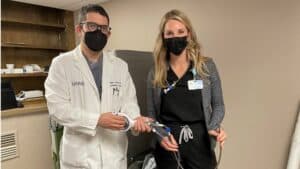
Subhi Al'Aref, M.D., and Malley Bailey hold the Alpha Vac device.
Subhi Al’Aref, M.D., and Malley Bailey hold the Alpha Vac device.

April 18, 2022 | LITTLE ROCK — A cardiologist at the University of Arkansas for Medical Sciences (UAMS) is the first physician in Arkansas to use a new device to remove infectious vegetation from a woman’s heart valve in a 45-minute minimally invasive procedure.

Subhi Al’Aref, M.D., an assistant professor in the Division of Cardiology in the Department of Internal Medicine in the UAMS College of Medicine, said the patient was a 28-year-old woman who had developed an infection in her tricuspid valve.

Although the infection was being treated with antibiotics, doctors wanted to remove it quickly before it could spread to other organs, or further damage the heart. However, heart surgeons deemed open-heart surgery too risky. Al’Aref said those factors and the woman’s young age created an opportunity to try out the AlphaVac, a portable device that received FDA approval in September for the nonsurgical removal of thrombi, emboli or clots from the venous system. The device resembles a vacuum cleaner hose with a squeeze handle.

On April 6, Al’Aref inserted a cannula on one end of the device into the woman’s right femoral vein through a small opening in the skin, as she lay on a table under anesthesia. Watching his progress on an echocardiogram, he then guided the cannula through the vein into the heart, stopping as he approached the wad of debris that was visible on the screen. Al’Aref then squeezed the handle, creating suction that gently pulled the debris into the cannula without stretching or harming the valve.

The captured vegetation was then sucked out of the body through the tubing, which expelled it into a clear waste bag, instantly removing the threat of a rapidly spreading, dangerous infection. The patient recovered immediately.

Al’Aref said the procedure can be done on an outpatient basis.

“It provides options for a lot of patients,” Al’Aref said. “It gives us hope for a lot of patients who otherwise don’t have options.”

Malley Bailey, a representative for AngioDynamics that makes the device, said the AlphaVac system is intended to be used with commonly available vascular access tools to facilitate the nonsurgical removal of thrombi, emboli or clots during minimally invasive percutaneous procedures.

Bailey said the device is being introduced in hospitals across the country, and UAMS is the first to use it in Arkansas and surrounding mid-South area.

The same company also makes the AngioVac system, with is used with a pump, filter and reinfusion cannula to avoid the need for open-heart surgery. The AngioVac also is commonly used to “vaccum out” undesirable intravascular material, but it requires the patient to be hooked up to a bypass machine and takes several hours to complete. The AlphaVac system doesn’t require the use of a bypass machine and is a much quicker and less invasive procedure.

Physicians in the UAMS Heart Center first used the AngioVac system in late 2020 to remove a large blood clot that was headed from a man’s heart into his lung, a situation known as thrombus-in-transit.

Posted by Chris Lesher on April 18, 2022

Filed Under: News

UAMS College of Medicine LogoUAMS College of MedicineUniversity of Arkansas for Medical Sciences
Mailing Address: 4301 West Markham Street, Little Rock, AR 72205
Phone: (501) 686-7000
  • Facebook
  • X
  • Instagram
  • YouTube
  • LinkedIn
  • Pinterest
  • Disclaimer
  • Terms of Use
  • Privacy Statement
  • Legal Notices

© 2025 University of Arkansas for Medical Sciences